Publications
-
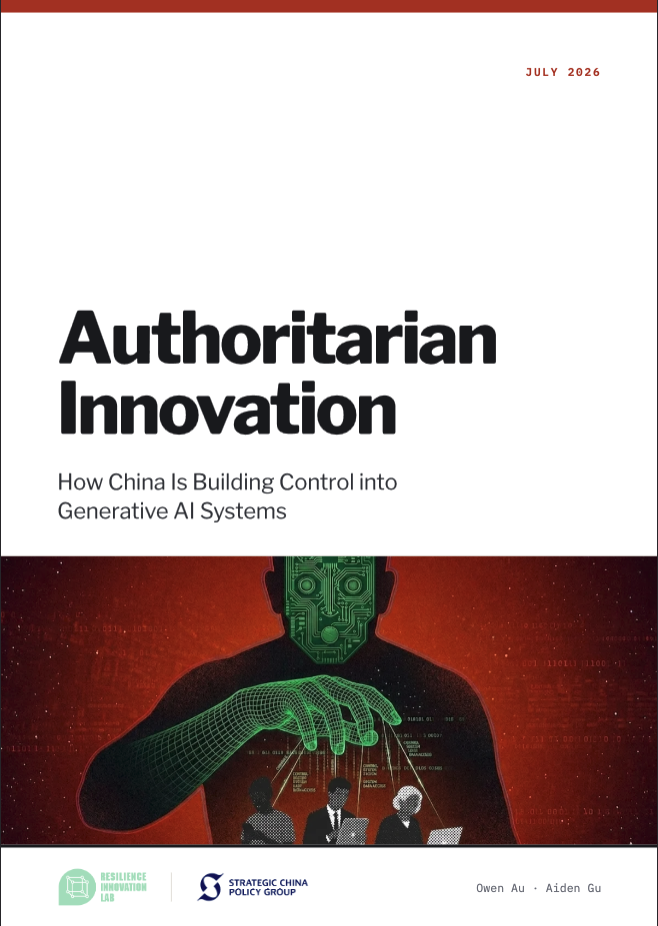
Authoritarian Innovation: How China Is Building Control into Generative AI Systems
(Scroll Down for Traditional Chinese version) Written by Resilience Innovation Lab (RIL) and Strategic China Policy Group (SCPG), the latest report, Authoritarian Innovation: How China Is Building Control into Generative AI Systems, draws on official sources and technical standards to examine how Beijing is embedding information control into large language models through its content security framework, standards, and model governance. Key findings: Read the report here. 威權創新:中國如何將管控植入生成式人工智能系統 韌性創新實驗室(Resilience Innovation Lab, RIL)與Strategic China Policy Group (SCPG)合著的最新報告《威權創新:中國如何將管控植入生成式人工智能系統》(Authoritarian Innovation: How China Is Building Control into Generative AI Systems),透過官方資料及技術標準,探討北京如何透過其內容安全框架、行業標準及模型治理機制,將資訊管控嵌入大型語言模型之中。 報告重點: 請按此閱讀全文(只有英文版本)。
-

Increasing Constraints on the Information Environment in Hong Kong
The information environment in Hong Kong has been further tightened in light of recent developments. The Ombudsman, traditionally regarded as a government watchdog, has removed decades’ worth of annual and investigative reports, along with other documents dated prior to 2023, from its website. The stated rationale for this action is the need for more effective website management. As a result, the publicly accessible archive of the Ombudsman’s reports has been reduced from the previous ten years to merely three. Access to reports predating 2023 is now restricted and only available upon written request. Lawmakers from the “patriots-only” legislature have criticised…
-

Berkeley Protocol – Archival Activism and Advocacy
The Berkeley Protocol on Digital Open Source Investigations (The Protocol) is a pioneering initiative aimed at standardising the use of open-source information in investigations into human rights abuses and war crimes. Developed by the Human Rights Center at the University of California, Berkeley, it represents a significant step forward in the ethical and legal use of open-source intelligence (OSINT), including content collected from social media posts, videos, and other publicly accessible online sources. This framework is essential for helping investigators collect, verify, and present evidence in a way that meets international legal standards—an essential process for holding perpetrators of human…
-

Archival Activism and Web3
Archival activism refers to the practice of preserving, organising, and presenting historical archives—not merely as a method of documentation, but as a means of promoting social justice and human rights. It is therefore both a means and an end. This form of activism seeks to bring to light overlooked histories, silenced voices, and deliberately forgotten stories, thereby fostering social reflection and transformation. The technological principles of Web3—freedom, immutability, and decentralisation—are closely aligned with the goals of archival activism. Its emphasis on open access allows anyone to participate in the preservation and sharing of archives. Immutability ensures that the content of…
-

Report Launch: Safeguarding Freedom of Information in Hong Kong |研究報告:維護香港的資訊自由
The report explores the current state of information freedom in Hong Kong, the challenges and the path forward in ensuring an open and informed society.
-
Latest Publication: Web3-backed Digital Archiving: User Guide For Beginners
Our first publication, “Decentralized Archiving: A Beginner’s Guide to Web3 Preservation”!