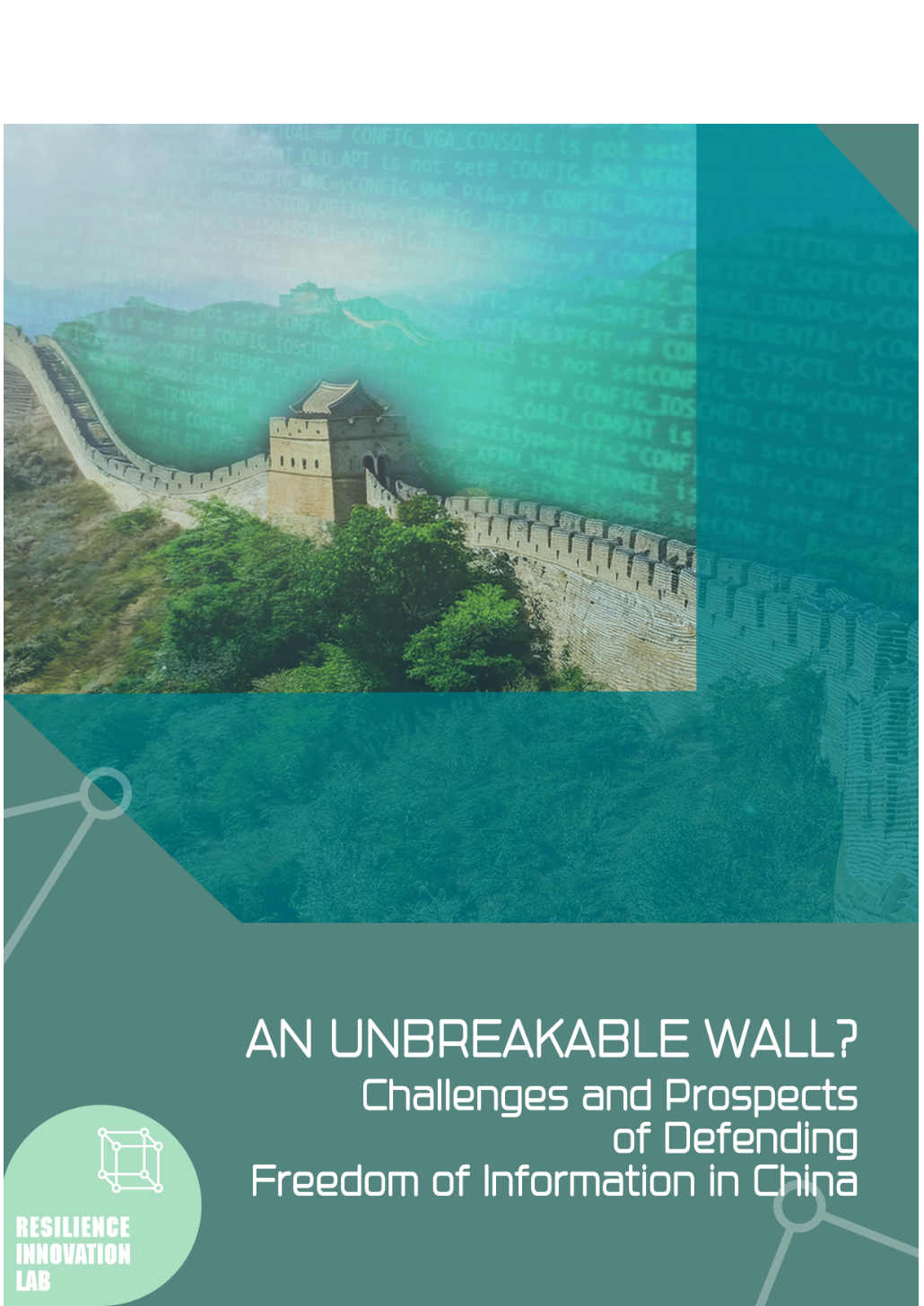
An Unbreakable Wall? Challenges and Opportunities of Defending Freedom of Information in China
This report provides a comprehensive account of China’s information environment under the rule of the CCP. Drawing on evidence-based insights from multiple perspectives, the report seeks to inform a broad range of stakeholders—from policymakers and international businesses to civil society organisations and academic institutions—and encourages collaborative efforts to address the challenges posed by China’s information landscape and its impact on global information networks. The full report is now available on our website.
Table of Contents
TABLE OF CONTENTS
ABOUT US
EXECUTIVE SUMMARY
- INTRODUCTION
- INFORMATION ENVIRONMENT IN THE PEOPLE’S REPUBLIC OF CHINA: AN OVERVIEW
2.1 XI’S EMPHASIS ON PRC’S CYBER SOVEREIGNTY
2.2 REINFORCING EXISTING REGULATIONS
2.3 CREATION OF A NEW LEGAL FRAMEWORK FOR CYBER GOVERNANCE - CCP’S CURRENT APPROACHES TO CHINA’S INFORMATION ENVIRONMENT
3.1 WHY HAS THE INFORMATION ENVIRONMENT BEEN TIGHTENED?
3.2 WHAT ARE THE APPROACHES? - IMPACTS ON THE PRIVATE SECTOR
4.1 RAPID GROWTH OF CHINA’S BUSINESS INTELLIGENCE AND DUE DILIGENCE INDUSTRY BEFORE THE STATE CRACKDOWN
4.2 STATE CRACKDOWN ON DUE DILIGENCE
4.3 STATE CRACKDOWN ON DUE DILIGENCE WORK ABOUT XINJIANG
4.4 EXIT BANS ON EXECUTIVES OF DUE DILIGENCE CONSULTANCIES
4.5 INFORMAL WARNINGS
4.6 CHILLING EFFECTS ON THE DUE DILIGENCE SECTOR
4.7 OFFICIAL FIREWALLS OBSTRUCTING DUE DILIGENCE - IMPACTS ON CIVIL SOCIETY STAKEHOLDERS
5.1 IMPACT ON CIVIL SOCIETY
5.2 IMPACT ON JOURNALISTS
5.3 ON ACADEMICS - UPCOMING CHALLENGES FOR INFORMATION FREEDOM IN CHINA
6.1 EXTERNAL FACTORS: GEOPOLITICAL UNCERTAINTY AND TRANSNATIONAL SURVEILLANCE
6.2 INTERNAL FACTORS: TIGHTENING CONTROL AMID ECONOMIC INSTABILITY
6.3 TECHNOLOGICAL REINFORCEMENT OF CONTROL THROUGH AI AND “SMART GOVERNANCE”
6.4 BREAKDOWN OF CONVENTIONAL MITIGATIONS: HONG KONG AND BUSINESS AUTONOMY - CONCLUSION AND RECOMMENDATIONS
7.1 STATE ACTORS
7.2 MULTILATERAL INSTITUTIONS
7.3 INTERNATIONAL BUSINESS SECTOR AND MULTINATIONAL CORPORATIONS (MNCS)
7.4 GLOBAL CIVIL SOCIETY AND ACADEMIC INSTITUTIONS
Foreword / Executive Summary
Executive Summary
Over the past decade, China’s information environment has deteriorated significantly as state control over digital communication has intensified. Major expansions of censorship and surveillance have coincided with significant political and social events, including the 2019 Hong Kong protests, the COVID-19 pandemic in 2020, and the White Paper Movement in 2022.
The Chinese Communist Party (CCP) has systematically tightened its control over cyberspace, driven by concerns about foreign ideological influence and domestic regime security. Its approach combines extensive digital surveillance, narrative control through media and information management, and reinforced digital border controls, including the Great Firewall. Recent legislative developments, including amendments to national security laws and new cybersecurity regulations, have further restricted information flows, affecting businesses, journalists, academics, and civil society organisations.
Businesses, particularly multinational corporations, face heightened operational and compliance risks in China’s increasingly restrictive information environment. Due diligence activities have been significantly constrained, with firms experiencing raids, exit bans, informal government warnings, and restricted access to critical corporate and commercial information databases.
Civil society organisations, journalists, and academics face similar constraints, including routine surveillance, censorship, and substantial disruption to their work. Academic freedom, journalistic independence, and civic activism are increasingly challenged by vague legal boundaries, intensified monitoring, and direct pressure from authorities.
Looking ahead, the outlook for information freedom in China remains concerning. Escalating geopolitical tensions, economic uncertainty, and the CCP’s expanding use of artificial intelligence for surveillance and governance are likely to deepen existing forms of information control. The erosion of conventional mitigation mechanisms, exemplified by the decline of Hong Kong’s autonomy, further compounds these challenges.
Policy Recommendations
- National governments should incorporate digital rights provisions into diplomatic engagements and trade agreements, supported by regular assessments of China’s digital governance and information-control policies.
- Multilateral institutions, including the World Bank, International Monetary Fund, and World Trade Organization, should promote regulatory standards that emphasise open access to information and strengthen mechanisms for monitoring digital repression and restrictions on information flows.
- Businesses should conduct continuous risk assessments, supported by chambers of commerce and industry associations, and adopt a Business and Human Rights Charter aligned with international human rights standards.
- Civil society organisations, media, and academic institutions should proactively preserve information at risk of censorship or removal, strengthen international collaboration, and develop strategies to safeguard historical and contemporary records for future generations.