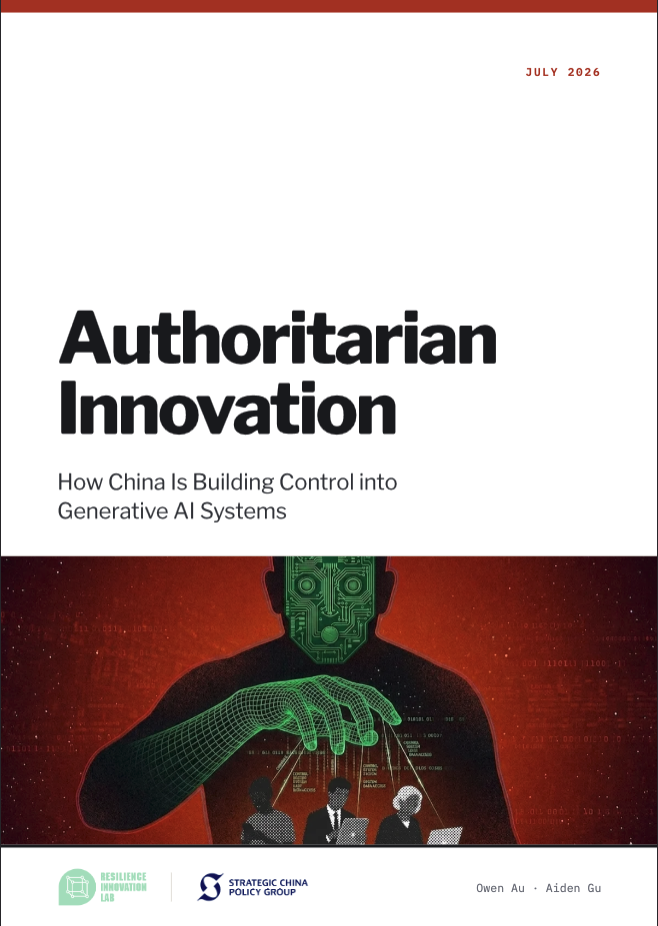
威權創新:中國如何將管控植入生成式人工智能系統(只有英文版本)
韌性創新實驗室(Resilience Innovation Lab, RIL)與Strategic China Policy Group (SCPG)合著的最新報告《威權創新:中國如何將管控植入生成式人工智能系統》(Authoritarian Innovation: How China Is Building Control into Generative AI Systems),透過官方資料及技術標準,探討北京如何透過其內容安全框架、行業標準及模型治理機制,將資訊管控嵌入大型語言模型之中。
報告重點:
- 中國將偏離黨的敘事的內容視為「內容安全」風險,並自源頭起將管控嵌入人工智能系統
- 一套不斷擴張的行業標準體系,正涵蓋訓練數據、模型行為及內容測試等生成式人工智能全流程
- 阿里巴巴、DeepSeek 等私營企業不僅受監管,更被納入治理體系本身
- 隨著中國模型全球擴散(全球十大主流大型語言模型中已有七個來自中國),這套管控邏輯亦隨之外溢
Table of Contents
- Foreword
- Executive Summary
- Introduction
- Part I: Foundations of China’s Information Control
- Quest for Ideological Security
- Content Security Risks in the Age of Generative AI
- Part II: Extending Control in the Age of Generative AI
- Strengthening Cyberspace Governance
- Governing the Generative AI Pipeline
- Industrial Standardisation
- Part III: The State-Corporate Nexus
- Reconfiguring the Dynamics
- Incorporation into the Governance System
- Standardisation as Political Incorporation
- Part IV: Exporting China Model
- Scale of Adoption
- Persistent Control
- Dependency Risk
- Discussion
- Annex A
- Annex B
- Annex C
- Endnotes
Foreword / Executive Summary
The governance of artificial intelligence (AI) has moved, within a remarkably short span, from a specialist concern to one of the defining questions of global order. Yet the debate it has provoked is not converging towards a shared framework; it is diverging. As states, corporations, and multilateral bodies scramble to set rules for a technology whose trajectory none of them fully controls, the underlying disagreement is less about technical standards than about the values, interests, and conceptions of authority those standards are intended to encode.
At least two broad currents run through this debate. The first is avowedly value-based. In his first encyclical, Magnifica Humanitas (15 May 2026), Pope Leo XIV frames the age of artificial intelligence as a test of whether humanity will build “yet another Tower of Babel” or instead rebuild a shared civic home.¹ He places human dignity, the common good, subsidiarity, and solidarity at the centre of any legitimate technological order, warning against a technocratic paradigm in which efficiency, control, and profit are permitted to dictate what matters and what may be discarded.
The second current is more explicitly pragmatic, organised around national interest and control. The Trump administration’s recent decision to vet access to OpenAI’s most advanced model on a customer-by-customer basis—restricting its release to a small circle of approved partners on national security grounds—illustrates how even the most market-oriented systems are folding frontier AI into the machinery of strategic competition.² Between these two impulses—moral universalism and security pragmatism—much of the rest of the world is left to find its footing.
Against this backdrop, China occupies a distinctive and frequently misread position. Amid mounting geopolitical uncertainty and the visible erosion of multilateral capacity, Beijing has signalled an ambition that extends well beyond the management of its own information space: it seeks to help write the rules for everyone else. In its new White Paper of 17 June 2026, More Just and Equitable Global Governance: China’s Principles, Proposals and Actions, the government presents itself as a champion of “AI for good and for all”. It pledges to support a central role for the United Nations, assist developing countries in bridging the AI divide, and convene new institutions—including a proposed World Artificial Intelligence Cooperation Organisation and a range of capacity-building initiatives—through which China would contribute its own approaches to the emerging global order.³ The register is inclusive, developmental, and reassuringly multilateral.
That outward-facing confidence, however, rests upon a domestic debate that is conspicuously muted. As one China human rights expert has observed, the relative quiet surrounding AI governance in China reflects control rather than consensus. Governance is shaped overwhelmingly by state mandates and regulatory agencies, while the courts, independent researchers, journalists, civil-society organisations, and labour and digital-rights groups that contest AI policy elsewhere have been systematically constrained or dismantled.⁴ Within politically permitted boundaries, experts may advise and citizens may complain, but these inputs do not constitute independent centres of pressure capable of shaping policy from outside the state-led framework.
The consequence is that what is presented internationally as “China’s” position on AI governance is, in practice, an official position, largely insulated from the pluralistic contestation that might otherwise temper it.
The present report, Authoritarian Innovation, contributes to this debate by examining China’s approach to AI governance through the lenses of national security, information control, and political economy. Within China’s broader framework of AI safety and security, content that departs from Party narratives or unsettles its ideological worldview is treated as a content-security risk to be managed. As Chinese generative AI models gain traction abroad, the Party-aligned content controls embedded within them may travel with the technology, extending into foreign information spaces without the need for overt information operations.
With Beijing seeking a larger role in global standard-setting, international regulators and developers would therefore do well to recognise that the language of “AI safety and security” can carry its own political and ideological freight. To overlook that context is to risk allowing authoritarian approaches to content control to shape the rules of global AI governance from within.
As China advances an approach to generative AI organised around the safeguarding of “content security”, it becomes all the more important for policy communities and civil society to preserve, archive, and disseminate reliable information and authentic government records. Such efforts can help resist the censorship, erasure, and fabrication of manipulated content that generative tools, when instrumentalised by authoritarian regimes such as China’s, increasingly make possible.
We hope this report reaches a wide audience and that, by engaging strategically with the current debate from a Chinese-speaking stakeholder perspective, it contributes a voice too often absent from these discussions. In an age of pervasive censorship and information manipulation, the production, preservation, and dissemination of knowledge are not peripheral activities but essential means of resistance. It is in that spirit that we offer this report, in the hope that it contributes, in some measure, to forestalling the autocratisation of AI governance.
Resilience Innovation Lab