Welcome to Resilience Innovation Lab (RIL). Before going into this month’s newsletter, we would like to offer our heartfelt condolences to the families and loved ones affected by last month’s Wang Fuk Court fire in Tai Po District, Hong Kong. Our thoughts are with the community during this time of sorrow and loss.
In this newsletter, we will share updates on the community’s efforts to document the Wang Fuk Court fire and the government’s response in Hong Kong, along with RIL’s Christmas good-read list for 2025.
As we approach the Christmas season and the year’s end, RIL extends its wishes for rest, reflection, and renewed strength. This period reminds us of the importance of resilience, solidarity, and care for one another, especially in times of hardship. RIL remains committed to advancing human rights and collective wellbeing through uses of technology, and to standing with communities working toward a more just and humane future.
After the Wang Fuk Court Fire, Accountability Came Under Pressure
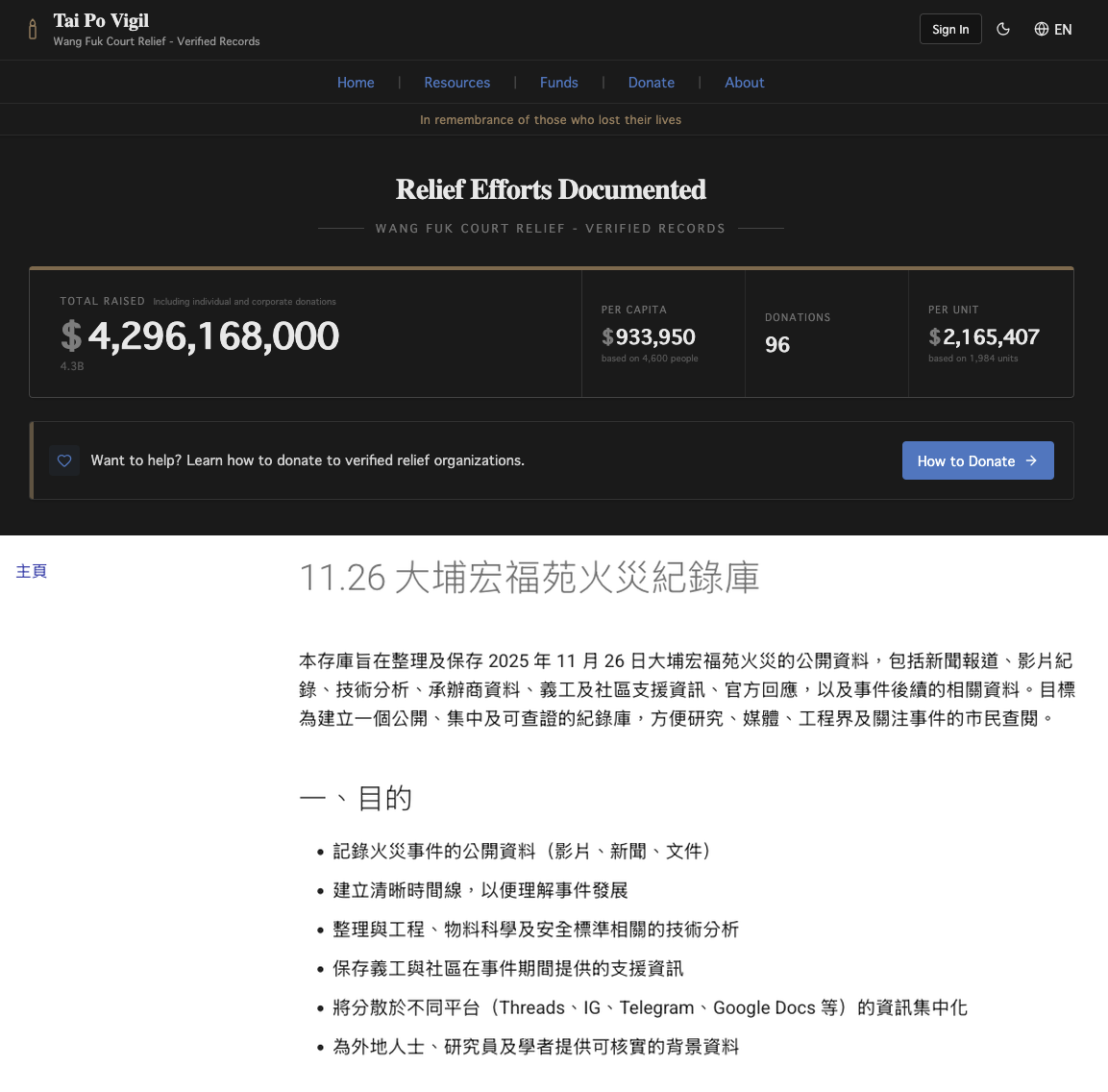
During the Wang Fuk Court fire in Hong Kong, members of the public began documenting information related to the incident. As a result of these efforts, multiple websites and online resources were set up and shared on social media for different purposes, including
monitoring, investigation, and censorship prevention. After the fire, a university student launched a petition with “four demands,” including the establishment of an independent Commission of Inquiry. The petition gathered over 10,000 signatures before being cracked down on by the Hong Kong Police. An identical petition was launched by another individual after the initiator of the original petition was arrested, which has also gathered over 10,000 signatures so far.
The Hong Kong government subsequently began to silence individuals who demanded accountability. The National Security Department of the Hong Kong Police arrested multiple people on charges of sedition, including the initiator of the petition, a former district councillor, and a volunteer. Prominent figures who shared and commented on news and developments related to the fire on social media announced that they would stop posting about the incident, indicating that they had faced pressure from the authorities. The pro-democracy political party Hong Kong Association for Democracy and People’s Livelihood (ADPL) cancelled its press conference on high-rise building maintenance policy after the party’s chair was taken away by national security police.
Beijing’s Office for Safeguarding National Security in Hong Kong also summoned foreign media outlets and issued warnings against what it described as “false information” or “smearing” of the government’s response to the fire.
The crackdown indicates that Hong Kong’s governance model has shifted toward prioritising stability and order over truth and accountability. The rapid and harsh response from the authorities also reflects that censorship-resistant technologies have become increasingly important for documentation and archiving in post–National Security Law Hong Kong.
Christmas Good Reads 2025
As the year draws to a close, Christmas offers a rare opportunity to slow down, reflect, and read with intention. This year’s Christmas Good Reads bring together books that go beyond surface-level trends, exploring the deeper ideas shaping our technologies, financial systems, and societies.
From the evolution of the internet to the social implications of blockchain, power, ownership, and collective imagination, these titles invite us to think critically about where we have come from—and where we may be heading next. Whether you are encountering these ideas for the first time or looking to deepen your understanding, each book offers something thoughtful, enduring, and worth sitting with over the holidays.
1. Read Write Own — Chris Dixon
Chris Dixon is a veteran Silicon Valley investor who has been involved in the development of the internet since its earliest Web1 days. He is among the rare few who have personally witnessed—and actively participated in—all three generations of the web’s evolution. In Read Write Own, Dixon revisits the history of the internet in a clear, accessible, and grounded style, showing how the Web2 era gradually drifted away from the original ideal of the free flow of information due to excessive centralisation.
He goes on to explain how blockchain technology introduces an entirely new “ownership layer” to the internet—one that allows users not only to read and write, but to genuinely own the value and identity they create online. This book is ideal for readers who enjoy understanding technology through a historical lens, as well as for those curious about blockchain but keen to avoid being overwhelmed by jargon. Offering a lucid and inspiring vision of the internet’s future, it is a must-read work of technological reflection.
2. Check Your Financial Privilege — Alex Gladstein
The phrase “check your privilege” emerged from recent progressive movements as a reminder to consider how one’s background, resources, and social position shape one’s understanding of public issues. In Check Your Financial Privilege, Alex Gladstein, Chief Strategy Officer at the Human Rights Foundation, extends this idea further—urging readers to re-examine not only social identity, but also financial privilege.
Gladstein points out that only around 20 per cent of the world’s population is fortunate enough to be born in countries with strong reserve currencies. In many other parts of the world, people are forced to contend with hyperinflation, corrupt regimes, and capital controls. The book also introduces the concept of “economic terrorism”, describing how authoritarian governments use extreme measures to punish citizens who hold foreign currencies, thereby reinforcing political control.
Through extensive first-hand interviews, Gladstein illustrates how activists across the globe are using Bitcoin and other cryptocurrencies as tools to resist authoritarianism, corruption, and neo-colonial power structures. Requiring no technical background, this is a sincere and compelling book that anyone concerned with economic justice and human rights should read.
3. The Infinite Machine: How an Army of Crypto-hackers Is Building the Next Internet with Ethereum — Camila Russo
Written by journalist Camila Russo, The Infinite Machine draws on incisive reporting and rigorous field research to take readers inside one of the most disruptive technological innovations of the past decade: the birth of Ethereum. Rich in first-hand interviews with core developers—including co-founder Vitalik Buterin—the book documents a technological revolution while reading like a fast-paced novel: gripping, vivid, and highly accessible.
With 2025 marking Ethereum’s tenth anniversary, the book feels especially timely. No prior knowledge of blockchain is required; the power of the story itself carries the reader along. Russo clearly articulates her aim:
“My intention is that anyone, anywhere, will be able to pick this up, without prior knowledge of blockchain technology, and be captivated by a fascinating story: an idealistic hero, his band of misfits, and the challenges they face to make their incredibly ambitious dream a reality.”
More than a history of technology, The Infinite Machine is an adventure about ideals, rebellion, collaboration, and the creation of the future. For readers interested in technology, finance, or social innovation, it remains one of the most rewarding books to revisit at this milestone moment.
4. The Sociology of Blockchain: Reimagining Money, Media and Democracy — Kin Ko
While the previous titles largely come from the English-speaking world, the Chinese-language sphere has its own influential voice: Kin Ko, founder of DHK DAO and LikeCoin. The Sociology of Blockchain: Reimagining Money, Media and Democracy is widely regarded as a foundational introduction to blockchain thinking within the Chinese-speaking world.
This is not simply a book about technology; it is a book written for everyone. As Kin Ko himself puts it, it is written for all the “Muggles” of the world. Even without any technical background, readers can gain a clear understanding of how blockchain is deeply intertwined with monetary systems, media ecosystems, and democratic institutions. At the same time, readers already familiar with the technology will find the book rich in insights that prompt reflection and renewed perspective.
Full of vision and critical awareness, the book reveals new ideas and fresh inspiration each time it is revisited. If you wish to understand the social questions blockchain is genuinely attempting to address—rather than focusing solely on technical mechanisms—this book is an ideal entry point, and one well worth returning to.
5. Proof of Stake — Vitalik Buterin
For readers ready to go beyond introductory material while still valuing clarity and thoughtfulness, Proof of Stake is essential reading. Written and curated by Vitalik Buterin himself, this collection brings together years of blog posts and speeches, carefully organised to guide readers through his broader thinking on Ethereum, crypto-networks, and the future of society.
Unlike conventional blockchain books, Proof of Stake serves as a window into the mind of a technological innovator, revealing how Vitalik analyses the complex relationships between social institutions, economic incentives, governance models, and technological evolution. His writing remains characteristically calm, rigorous, and deeply insightful, reading like an extended conversation that moves from Proof of Stake and Ethereum governance to wider reflections on human coordination and digital futures.
This book is particularly suited to readers who are no longer satisfied with surface-level explanations and want to engage more deeply with the philosophy and vision behind Ethereum and blockchain. It is not a dense technical manual, but a collection of ideas that may fundamentally reshape how you think about decentralisation, public goods, and the digital societies yet to come.
Useful Resources
Judicial Records in Hong Kong * has made every effort to collect court decisions related to the Anti-Extradition Bill Movement for educational and research purposes. These records are still accessible on the website of Hong Kong’s judiciary, but their continued availability to the public in the future remains uncertain. All judicial records collected and displayed here are secured and maintained using blockchain technology, through which they are decentralized and immutable, ensuring transparency, tamper-resistance, and trust in the integrity of the data. Our goal is to utilize blockchain as a form of censorship resistance to preserve invaluable public records. If there are any omissions in this database, please feel free to notify RIL’s research team: info.dap@protonmail.com .
China Open Courts * aims to preserve and provide public access to judicial records from the People’s Republic of China that are at risk of disappearing from official sources. Below is an overview of the methodology adopted in this project, including our data collection strategies, scope of coverage, and plans for ensuring continued accuracy and relevance of the information. Interested parties are welcome to reach out to our team at chinaopencourts@protonmail.com for further information, collaboration opportunities, or suggestions on additional keywords and topics to include.
*To protect your identity and personal information, you are advised to use these online resources with an encrypted device and VPN.
An Unbreakable Wall? Challenges and Opportunities of Defending Freedom of Information in China is RIL’s first research report on information environment in China. This report provides a comprehensive account of China’s information environment under the rule of the CCP. Drawing on evidence-based insights from multiple perspectives, the report seeks to inform a broad range of stakeholders—from policymakers and international businesses to civil society organisations and academic institutions—and encourages collaborative efforts to address the challenges posed by China’s information landscape and its impact on global information networks. The full report is now available on our website.
Safeguarding Freedom of Information in Hong Kong: Challenges, Opportunities and Remedies is RIL’s second research report, focuding on information freedom in Hong Kong. The report systematically outlines how Hong Kong’s information access environment has been significantly constrained since the implementation of the Hong Kong National Security Law (HKNSL) in 2020 and the Safeguarding National Security Ordinance (SNSO) in 2024. These measures have severely curtailed press freedom and undermined the ability of civil society to hold the government accountable. They have encouraged the withholding of publicly available data and represent a departure from international human rights standards. Access to and dissemination of information is increasingly criminalised, resulting in diminished government transparency, suppression of the media, and reduced accessibility to data for businesses. The repercussions are being felt by journalists, the business sector, researchers, and international organisations alike. The report is published bilingually on our website.

Who we are?
Resilience Innovation Lab (RIL) was founded by Asian veteran researchers and human rights defenders in 2023. RIL is a virtual platform promoting innovation, experimentation, and the exchange of research and educational initiatives that aim to develop and strengthen the democratic and digital resilience of organisations and individuals working in repressive environments.
RIL envisions a synergy of democracy, technology and civil society resilience today, especially when authoritarianism emerges as a common threat to liberal democracies and open societies. Building the capacities of citizens and civil groups to respond to such a new environment with creative and innovative instruments is of paramount importance for their sustainable development.
Our work focuses on researching Web3 technology, digital preservation of collective memory and history in conflict and post-conflict areas, and resilience of rule of law institutions and cultures in non-democratic regimes.
Enquiry: info.ril@proton.me