Welcome to Resilience Innovation Lab (RIL). In this newsletter, we will share updates on RightsCon 2026 and upcoming archiving workshop co-hosted by RIL.
RightsCon 2026 cancellation raises alarm over Chinese interference

RightsCon 2026, the global summit on human rights and technology due to take place in Lusaka, Zambia, from 5–8 May, was effectively cancelled days before it was scheduled to open after the Zambian government announced an open-ended postponement. The event was expected to bring together thousands of participants from more than 150 countries to discuss digital rights issues including censorship, surveillance, AI governance, disinformation and internet shutdowns.
Access Now, the organiser of RightsCon, said it believes the cancellation was driven by foreign interference from the People’s Republic of China. According to the organisation, Zambian officials indicated that Chinese diplomats had objected to the participation of Taiwanese civil society representatives. Access Now also said it was later informed through informal channels that the event could only proceed if certain topics were moderated and at-risk communities, including Taiwanese participants, were excluded from both in-person and online participation.
The incident has raised wider concerns about China’s ability to exert pressure beyond its borders in order to shape international civic spaces. Human rights groups have described the reported intervention as part of a broader pattern of transnational repression, particularly around efforts to exclude Taiwanese voices and limit criticism of authoritarian technology practices. Amnesty International characterised the postponement as an apparent act of Chinese transnational repression, while Human Rights Watch said the decision raised concerns about both Zambia’s commitment to free expression and possible Chinese government interference.
For the global digital rights community, the cancellation is more than a logistical setback. It highlights how geopolitical pressure, particularly from powerful states such as China, can restrict who is allowed to take part in global human rights conversations and what issues can be discussed. It also raises urgent questions about the independence of international convenings, the protection of Taiwanese and other at-risk civil society actors, and the shrinking space for open debate on technology, democracy and human rights.
Hong Kong’s annual archive destruction figures are a timely reminder of the need for an Archives Law
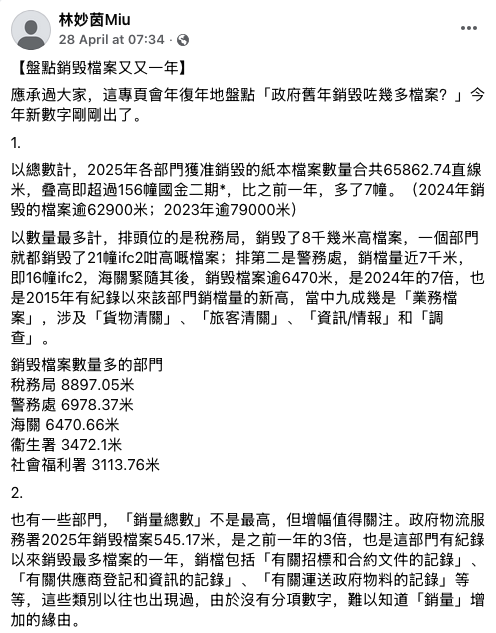
A recent social media post by Hong Kong journalist Miu Yan Lam reviews newly released figures on government records approved for destruction in 2025, continuing her annual effort to track how much public material is being discarded. According to the post, government departments were approved to destroy 65,862.74 linear metres of paper records in 2025 — enough, if stacked vertically, to exceed the height of 156 Two IFC Towers. This was higher than 2024, when more than 62,900 metres were destroyed, but lower than the 2023 figure of more than 79,000 metres.
The largest volumes came from the Inland Revenue Department at 8,897.05 metres, followed by the Hong Kong Police Force at 6,978.37 metres and the Customs and Excise Department at 6,470.66 metres. Lam notes that Customs’ figure was about seven times its 2024 level and appears to be the department’s highest since records began in 2015, with most of the destroyed files classified as programme records relating to cargo clearance, passenger clearance, intelligence and investigations.
The post also highlights departments where the overall volume was lower but the year-on-year increase was notable. The Government Logistics Department destroyed 545.17 metres of records, roughly three times the previous year and its highest recorded figure. The Independent Commission Against Corruption destroyed more than 536 metres, including files relating to media publicity, external affairs, investigation cases and operational support. The Buildings Department destroyed 1,398 metres, a five-year high, while the Home Affairs Department rose to 1,345.52 metres.
The broader concern raised by Lam’s post is not simply the quantity of records destroyed, but the weakness of Hong Kong’s public archives regime. Under the current system, departments must seek approval before destroying government records, but critics have long argued that the framework relies too heavily on administrative rules rather than legally binding obligations.
The post connects the latest destruction figures to the long-delayed debate over an Archives Law. Hong Kong’s Ombudsman previously recommended legislation to strengthen public records management, while the Law Reform Commission began studying the issue in 2013 and published a consultation paper in 2018. However, more than seven years after that consultation, its final report has still not been released.
Lam presents the annual tally as a reminder that without stronger legal safeguards, independent oversight and clearer disclosure, the destruction of government records may continue to outpace public understanding of what is being lost.
Archiving as Action: Community Archives Practice Workshop
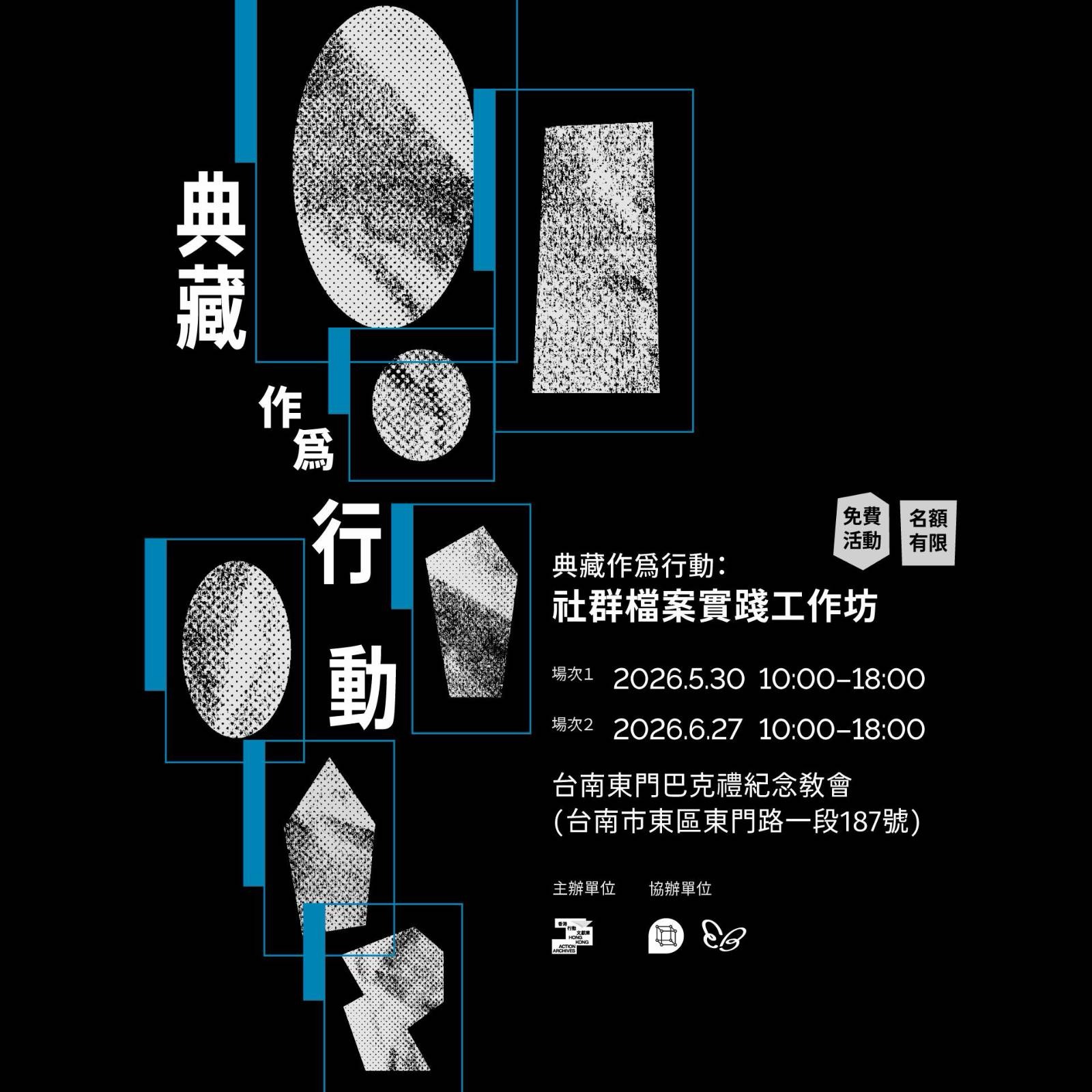
RIL is pleased to co-host “Archiving as Action: Community Archives Practice Workshop” (典藏作為行動:社群檔案實踐工作坊), a two-part, full-day workshop series exploring how communities can preserve their own histories and turn collective memory into a foundation for future action.
Rather than waiting for others to document our past, the workshop invites participants to take an active role in recording, organising and safeguarding community memories. Across theory and hands-on practice, participants will learn about archive activism, community archives and diverse approaches to preservation, while gaining beginner-friendly skills in caring for physical materials and cultural objects.
The workshops will take place at Tainan East Gate Barclay Memorial Church in Taiwan, whose own work in heritage preservation and social practice will be introduced through a guided visit. Each session will also feature experience-sharing from practitioners involved in movement documentation, community memory work and advocacy.
We are grateful for the enthusiastic response and support from the community. Both sessions are now fully booked, and we thank everyone who registered, shared the event and helped make this workshop possible.
The workshop is organised by Hong Kong Action Archive, co-hosted by the social service department of Tainan East Gate Barclay Memorial Church and Resilience Innovation Lab.
Useful Resources
Judicial Records in Hong Kong * has made every effort to collect court decisions related to the Anti-Extradition Bill Movement for educational and research purposes. These records are still accessible on the website of Hong Kong’s judiciary, but their continued availability to the public in the future remains uncertain. All judicial records collected and displayed here are secured and maintained using blockchain technology, through which they are decentralized and immutable, ensuring transparency, tamper-resistance, and trust in the integrity of the data. Our goal is to utilize blockchain as a form of censorship resistance to preserve invaluable public records. If there are any omissions in this database, please feel free to notify RIL’s research team: info.dap@protonmail.com .
China Open Courts * aims to preserve and provide public access to judicial records from the People’s Republic of China that are at risk of disappearing from official sources. Below is an overview of the methodology adopted in this project, including our data collection strategies, scope of coverage, and plans for ensuring continued accuracy and relevance of the information. Interested parties are welcome to reach out to our team at chinaopencourts@protonmail.com for further information, collaboration opportunities, or suggestions on additional keywords and topics to include.
*To protect your identity and personal information, you are advised to use these online resources with an encrypted device and VPN.
An Unbreakable Wall? Challenges and Opportunities of Defending Freedom of Information in China is RIL’s first research report on information environment in China. This report provides a comprehensive account of China’s information environment under the rule of the CCP. Drawing on evidence-based insights from multiple perspectives, the report seeks to inform a broad range of stakeholders—from policymakers and international businesses to civil society organisations and academic institutions—and encourages collaborative efforts to address the challenges posed by China’s information landscape and its impact on global information networks. The full report is now available on our website.
Safeguarding Freedom of Information in Hong Kong: Challenges, Opportunities and Remedies is RIL’s second research report, focuding on information freedom in Hong Kong. The report systematically outlines how Hong Kong’s information access environment has been significantly constrained since the implementation of the Hong Kong National Security Law (HKNSL) in 2020 and the Safeguarding National Security Ordinance (SNSO) in 2024. These measures have severely curtailed press freedom and undermined the ability of civil society to hold the government accountable. They have encouraged the withholding of publicly available data and represent a departure from international human rights standards. Access to and dissemination of information is increasingly criminalised, resulting in diminished government transparency, suppression of the media, and reduced accessibility to data for businesses. The repercussions are being felt by journalists, the business sector, researchers, and international organisations alike. The report is published bilingually on our website.
Working with Difficult Records Series is a webinar series organised by The National Archives UK. This series explores how archives can engage with challenging and sensitive records through people-centred and trauma-informed approaches. Bringing together scholars, practitioners, and sector experts, the sessions share practical case studies, reflections, and strategies that emphasise care, empathy, and community in archival work. Participants will gain insight into managing distressing material, supporting wellbeing, and applying trauma-informed practices to strengthen both professional practice and funding opportunities, while also building a collaborative community of practice. Topics include working with traumatic histories, criminal justice, medical and mental health records, social justice collections, and beneficiary-focused archives.

Who we are?
Resilience Innovation Lab (RIL) was founded by Asian veteran researchers and human rights defenders in 2023. RIL is a virtual platform promoting innovation, experimentation, and the exchange of research and educational initiatives that aim to develop and strengthen the democratic and digital resilience of organisations and individuals working in repressive environments.
RIL envisions a synergy of democracy, technology and civil society resilience today, especially when authoritarianism emerges as a common threat to liberal democracies and open societies. Building the capacities of citizens and civil groups to respond to such a new environment with creative and innovative instruments is of paramount importance for their sustainable development.
Our work focuses on researching Web3 technology, digital preservation of collective memory and history in conflict and post-conflict areas, and resilience of rule of law institutions and cultures in non-democratic regimes.
Enquiry: info.ril@proton.me