Welcome to Resilience Innovation Lab (RIL). In this newsletter, we will share updates on further Hong Kong bookstore raids and latest RIL’s report.
Hong Kong Bookstore Arrests Deepen Concerns over Censorship and Cross-border Publishing

Hong Kong’s national security police arrested five people during coordinated raids on two independent bookstores on 15 July 2026, escalating a crackdown that had already targeted another bookseller in June. Officers searched Have a Nice Stay, founded by a former journalist, and the long-established Greenfield Bookstore, arresting two men and three women suspected of displaying and selling publications with “seditious intention.” Police alleged that the material encouraged hatred of the Hong Kong government, judiciary and law-enforcement agencies. The authorities said the investigation began after customs officials intercepted books in a shipment arriving from overseas.
The July operation followed a raid on Hunter Bookstore in June, during which its owner and her husband were arrested. Police accused the pair of selling or displaying allegedly seditious publications and of receiving funding from overseas political organisations. Together with an earlier March operation against Book Punch, the cases mean that at least four independent bookstores and 11 people were reportedly targeted between March and July.
The enforcement drive has been strengthened by amendments introduced in March 2026 that explicitly allow Hong Kong customs officers to seize articles they reasonably suspect of having a seditious intention, even when no arrest has been made. Security Secretary Chris Tang said booksellers themselves are responsible for ensuring that their stock does not endanger national security. At the same time, the government has rejected calls to publish a definitive list of prohibited books, arguing that legality depends on a publication’s contents rather than its title. For booksellers, this creates a compliance system in which they must assess potentially serious criminal risks without a clear catalogue of banned works.
The pressure has also spread into the supply chain. The Taiwanese subsidiary Jaguar Logistics, a company headquartered in Hong Kong, announced that it would not transport books deemed to breach Hong Kong law. It also required customers to submit book lists for examination before shipment and said it would refuse to serve bookstores under government investigation. According to The Collective, a Hong Kong local media, Taiwan’s Mainland Affairs Council said shipments of books ordered from Taiwan had faced customs inspections almost every time since March or April, compared with inspections only every few months previously.
The broader implication is that Hong Kong’s national-security regime is moving beyond prosecutions of prominent politicians, activists and media organisations into everyday cultural and commercial activity. This “chilling effect” can restrict access to books without requiring formal bans: uncertain legal boundaries encourage businesses to remove anything that might attract scrutiny. Independent stores are particularly vulnerable because they lack the legal and financial resources of large chains; both bookstores raided in July subsequently announced or accelerated their closure.
The repercussions extend beyond Hong Kong. Taiwanese publishers and readers responded to the arrests with public expressions of solidarity, while a book reportedly connected to the raids—Emily Feng’s Let Only Red Flowers Bloom—sold out at several Taiwanese bookstores and prompted an emergency reprint. Yet the logistics company’s restrictions demonstrate how Hong Kong’s security rules can influence the conduct of businesses operating in otherwise freer jurisdictions. The result may be a growing separation between Hong Kong and Taiwan’s Chinese-language publishing markets, with politically sensitive titles increasingly circulated in Taiwan while becoming harder to import, stock or discuss in Hong Kong.
Latest Report Examines How China Builds Information Control into Generative AI
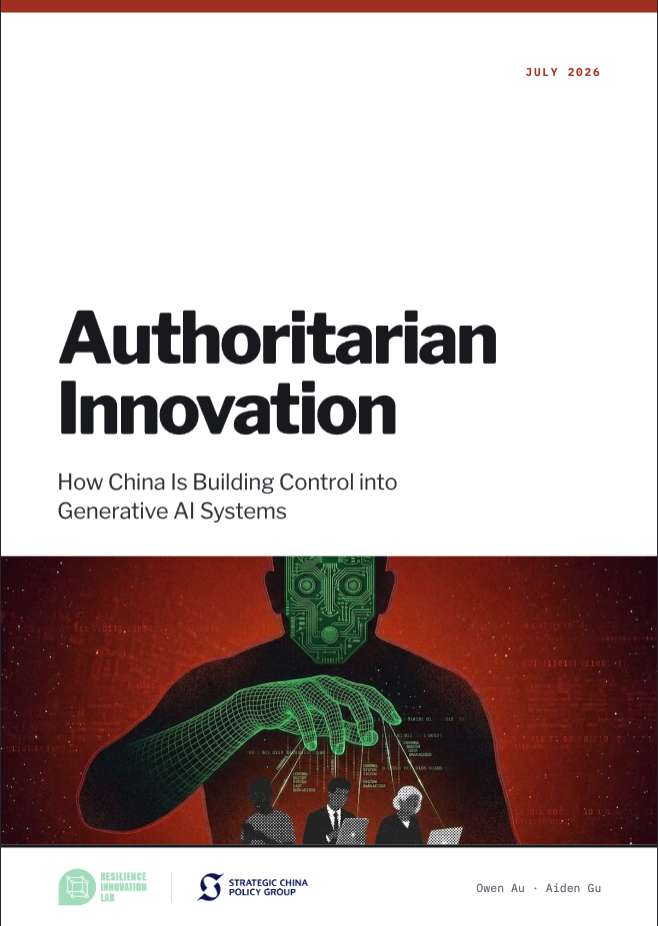
A new report by Resilience Innovation Lab and Strategic China Policy Group argues that China is embedding political and information controls directly into the design and governance of generative AI systems. Drawing on official documents and technical standards, Authoritarian Innovation: How China Is Building Control into Generative AI Systems examines how Beijing’s content-security framework shapes training data, model behaviour and testing requirements across the AI development process.
Key findings:
- China treats content that departs from Party narratives as a “content security risk” — built into AI systems from the ground up
- An expanding system of industrial standards now governs training data, model behaviour, and content testing across the entire AI pipeline
- Private firms like Alibaba and DeepSeek aren’t just regulated — they’re incorporated into the governance system itself
- As Chinese models spread abroad (7 of the world’s top 10 LLMs by usage are now Chinese), this control logic travels with them
The report has received coverage from multiple international and Taiwanese media outlets, including Radio Taiwan International, Radio France Internationale, Taiwan’s Central News Agency and the Liberty Times.
Read the report here.
RightsCon Announces Follow-up Activities After Cancellation of 2026 Event

Following the cancellation of RightsCon 2026, which had been due to take place in Zambia and online and was expected to bring together more than 5,000 digital rights advocates from around the world, the organiser, Access Now, have announced a new series of activities under the banner “RightsCon Continues” to sustain community exchange and advocacy. The first initiative will be a 24-hour global online summit on 22 September 2026, focused on resilience, adaptation and movement building. Through discussions, workshops, roundtables and networking sessions, the event will explore how the digital rights community can respond to an increasingly complex technology and human rights landscape. The organiser also plan to participate in partner events throughout the remainder of 2026, support community members in attending relevant conferences, and launch further initiatives to strengthen the global digital rights ecosystem.
Click here to read the full announcement.
Useful Resources
Judicial Records in Hong Kong * has made every effort to collect court decisions related to the Anti-Extradition Bill Movement for educational and research purposes. These records are still accessible on the website of Hong Kong’s judiciary, but their continued availability to the public in the future remains uncertain. All judicial records collected and displayed here are secured and maintained using blockchain technology, through which they are decentralized and immutable, ensuring transparency, tamper-resistance, and trust in the integrity of the data. Our goal is to utilize blockchain as a form of censorship resistance to preserve invaluable public records. If there are any omissions in this database, please feel free to notify RIL’s research team: info.dap@protonmail.com .
*To protect your identity and personal information, you are advised to use these online resources with an encrypted device and VPN.
An Unbreakable Wall? Challenges and Opportunities of Defending Freedom of Information in China is RIL’s first research report on information environment in China. This report provides a comprehensive account of China’s information environment under the rule of the CCP. Drawing on evidence-based insights from multiple perspectives, the report seeks to inform a broad range of stakeholders—from policymakers and international businesses to civil society organisations and academic institutions—and encourages collaborative efforts to address the challenges posed by China’s information landscape and its impact on global information networks. The full report is now available on our website.
Safeguarding Freedom of Information in Hong Kong: Challenges, Opportunities and Remedies is RIL’s second research report, focuding on information freedom in Hong Kong. The report systematically outlines how Hong Kong’s information access environment has been significantly constrained since the implementation of the Hong Kong National Security Law (HKNSL) in 2020 and the Safeguarding National Security Ordinance (SNSO) in 2024. These measures have severely curtailed press freedom and undermined the ability of civil society to hold the government accountable. They have encouraged the withholding of publicly available data and represent a departure from international human rights standards. Access to and dissemination of information is increasingly criminalised, resulting in diminished government transparency, suppression of the media, and reduced accessibility to data for businesses. The repercussions are being felt by journalists, the business sector, researchers, and international organisations alike. The report is published bilingually on our website.
Authoritarian Innovation: How China Is Building Control into Generative AI Systems is RIL’s third report. Co-authored with Strategic China Policy Group (SCPG), the report draws on official sources and technical standards to examine how Beijing is embedding information control into large language models through its content security framework, standards, and model governance.
Keeping Calm Amid Uncertainty: An Information Security Resilience Guide for Civil Society (Tradtional Chinese only) is a practical manual developed by RIL for Hong Kong civil society, diaspora communities, journalists, advocates, students, and community organisers seeking to strengthen their digital safety. The guide offers accessible advice on common information security risks, secure communications, device and account protection, AI-related privacy concerns, and digital preparation for travel or cross-border activities. Framing information security as both personal protection and collective care, the manual helps individuals and organisations reduce risks, safeguard trusted networks, and build stronger civic resilience in an uncertain political, legal, and technological environment.
Working with Difficult Records Series is a webinar series organised by The National Archives UK. This series explores how archives can engage with challenging and sensitive records through people-centred and trauma-informed approaches. Bringing together scholars, practitioners, and sector experts, the sessions share practical case studies, reflections, and strategies that emphasise care, empathy, and community in archival work. Participants will gain insight into managing distressing material, supporting wellbeing, and applying trauma-informed practices to strengthen both professional practice and funding opportunities, while also building a collaborative community of practice. Topics include working with traumatic histories, criminal justice, medical and mental health records, social justice collections, and beneficiary-focused archives.

Who we are?
Resilience Innovation Lab (RIL) was founded by Asian veteran researchers and human rights defenders in 2023. RIL is a virtual platform promoting innovation, experimentation, and the exchange of research and educational initiatives that aim to develop and strengthen the democratic and digital resilience of organisations and individuals working in repressive environments.
RIL envisions a synergy of democracy, technology and civil society resilience today, especially when authoritarianism emerges as a common threat to liberal democracies and open societies. Building the capacities of citizens and civil groups to respond to such a new environment with creative and innovative instruments is of paramount importance for their sustainable development.
Our work focuses on researching Web3 technology, digital preservation of collective memory and history in conflict and post-conflict areas, and resilience of rule of law institutions and cultures in non-democratic regimes.
Enquiry: info.ril@proton.me