Welcome to Resilience Innovation Lab (RIL). In this newsletter, we will share updates on Hong Kong’s new national security regulation, Hong Kong bookstore raid and latest RIL’s publication.
Hong Kong’s New National Security Regulation Raises Fresh Fair-Trial and Human Rights Concerns

On 9 June 2026, the Hong Kong government brought into immediate effect a new Safeguarding National Security (Procedural Matters) Regulation. The regulation says that when the Chief Executive certifies that conduct in a criminal case involves national security, the case will be treated as an “offence endangering national security” under Hong Kong’s National Security Law and the Safeguarding National Security Ordinance.
The human-rights concern is that the regulation strengthens the executive’s role in determining whether ordinary criminal conduct is classified as national-security-related, a label that can trigger stricter procedures and reduced safeguards. Amnesty International criticised this may undermine defendants’ rights throughout the legal process, including investigation, bail, trial, and release, because national-security cases in Hong Kong can involve a presumption against bail, trial by judges selected by the Chief Executive, and denial of early release.
The human-rights implications are serious: even without creating new crimes, the regulation may deepen legal uncertainty and further weaken fair-trial protections, judicial independence, and due process. It also risks expanding the chilling effect already felt by journalists, lawyers, activists, academics, civil society groups, and others who criticise the authorities, as speech, advocacy, foreign links, or information-sharing could more easily be treated as national-security matters.
Hong Kong Bookstore Raid Signals Shrinking Space for Independent Publishing

Hong Kong national security police raided a shop in Sham Shui Po on 24 June 2026 and arrested a 33-year-old woman and a 32-year-old man suspected of sedition and money-laundering-related offences. The government did not name them, but HKFP and other media identified the woman as Leticia Wong, owner of independent Hunter Bookstore, former pro-democracy district councillor, journalist, and editor-in-chief of Status Quo. Police alleged the shop displayed and sold publications that incited hatred against the Hong Kong government, judiciary, and law enforcement, and said the pair had received remittances funded by foreign political organisations.
The case appears to mark a further expansion of Hong Kong’s national-security enforcement into publishing and bookselling. CPJ called for Wong’s immediate release, saying the arrest shows authorities are pushing national-security laws deeper into the publishing sector. AP reported that Wong had previously said her shop had faced repeated official pressure, including inspections, patrols, warning letters, and disrupted events; the arrests also follow a March 2026 case involving another bookstore accused of selling “seditious” publications, including a biography of Jimmy Lai.
The raid highlights growing pressure on Hong Kong’s independent bookstores and publishing spaces, which may increasingly be treated as sites of political risk rather than cultural exchange. Even without formal bans, the threat of sedition allegations, police inspections or financial investigations could encourage pre-emptive self-censorship, narrowing the diversity of books available to readers and weakening bookstores’ role as spaces for public debate, historical memory and independent cultural expression.
Latest RIL Manaual Offers Digital Security Guidance for Hong Kong Civil Society and Diaspora Communities

RIL has published a new Traditional Chinese practical information security manual《處變不驚:公民社會資訊安全韌性指南》(literal translation: Keeping Calm Amid Uncertainty: An Information Security Resilience Guide for Civil Society) in June 2026 for Hong Kong civil society, diaspora communities, journalists, students, advocates, and anyone concerned about privacy and digital safety. Set against Hong Kong’s national security environment, extraterritorial risks, and growing digital surveillance concerns, the manual explains how online speech, communication records, social media accounts, organisational data, and personal devices can become sources of risk across borders.
The manual covers common cyber threats, surveillance technologies, device security, secure communications, risks linked to AI tools, digital safety preparations before and after travel, and practical tools for individuals and organisations. It offers not only background explanations, but also actionable guidance on emergency planning, border-crossing preparation, password management, two-factor authentication, encrypted email, secure messaging, VPNs, file encryption, and safer web browsing.
Its central message is that information security is not only about protecting oneself, but also about safeguarding family members, friends, sources, partners, and the wider community. In an uncertain political, legal, and technological environment, stronger digital security awareness can reduce the risks of surveillance, harassment, data leaks, account intrusion, and cross-border exposure, helping Hong Kong communities at home and overseas stay connected, support one another, and sustain civic resilience.
You may access the manual here (Traditional Chinese only).
RIL Launches East Asia Digital Threats Digest Offering Security Advice
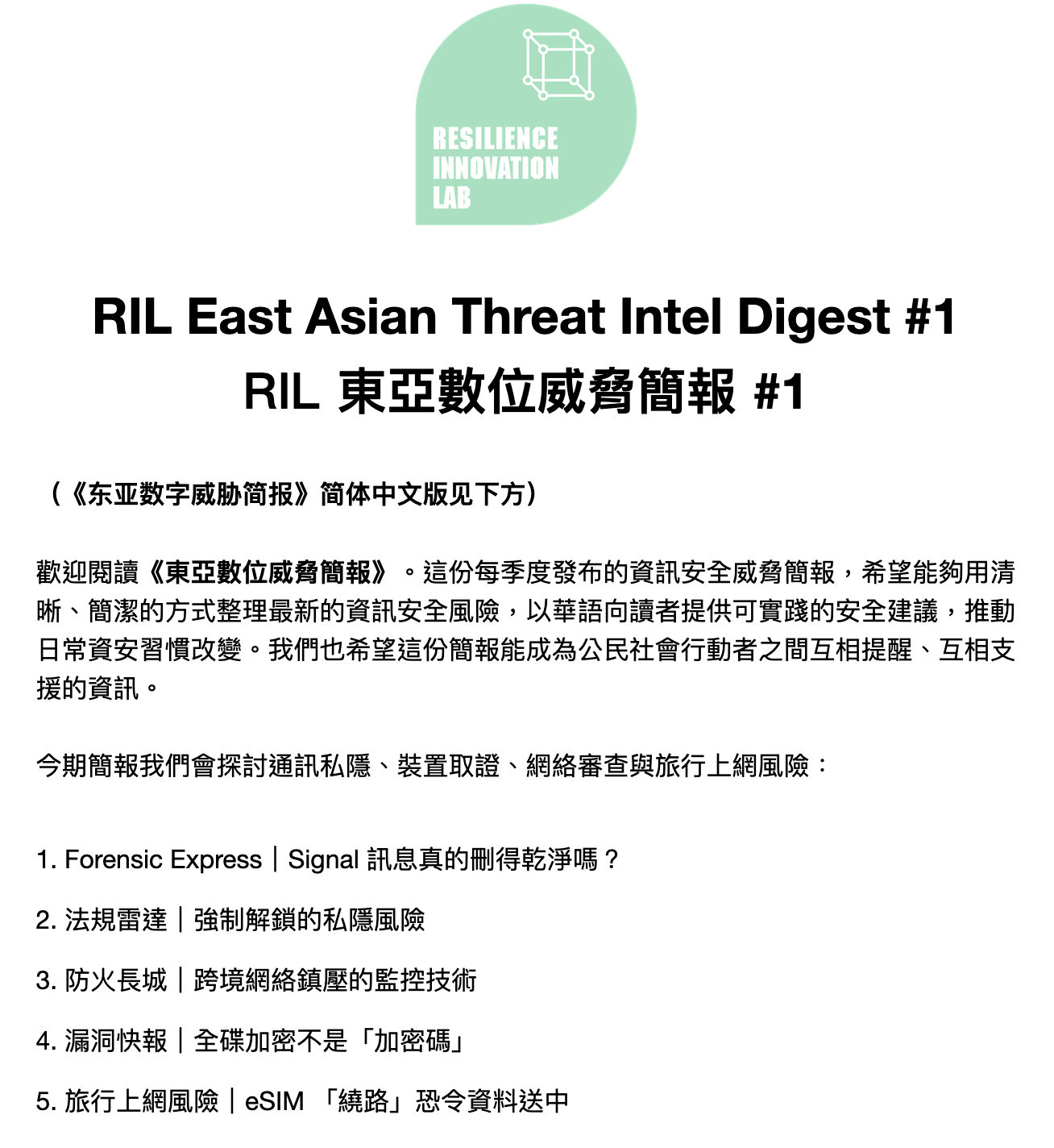
The first issue of the East Asian Threat Intel Digest has been released. In this issue, we explore topics including communications privacy, the risks of using travel eSIMs for internet access, and the use of Signal notification logs as evidence in legal case. We also provide practical steps that every reader can take in response.
Published quarterly in both Traditional Chinese and Simplified Chinese, this digest aims to highlight the latest information security risks, offering practical security advice to readers and support safer everyday digital practices. We also hope this digest can serve as a resource for civil society actors to remind and support one another.
You can read this issue here.
You are also welcome to subscribe.
Useful Resources
Judicial Records in Hong Kong * has made every effort to collect court decisions related to the Anti-Extradition Bill Movement for educational and research purposes. These records are still accessible on the website of Hong Kong’s judiciary, but their continued availability to the public in the future remains uncertain. All judicial records collected and displayed here are secured and maintained using blockchain technology, through which they are decentralized and immutable, ensuring transparency, tamper-resistance, and trust in the integrity of the data. Our goal is to utilize blockchain as a form of censorship resistance to preserve invaluable public records. If there are any omissions in this database, please feel free to notify RIL’s research team: info.dap@protonmail.com .
China Open Courts * aims to preserve and provide public access to judicial records from the People’s Republic of China that are at risk of disappearing from official sources. Below is an overview of the methodology adopted in this project, including our data collection strategies, scope of coverage, and plans for ensuring continued accuracy and relevance of the information. Interested parties are welcome to reach out to our team at chinaopencourts@protonmail.com for further information, collaboration opportunities, or suggestions on additional keywords and topics to include.
*To protect your identity and personal information, you are advised to use these online resources with an encrypted device and VPN.
An Unbreakable Wall? Challenges and Opportunities of Defending Freedom of Information in China is RIL’s first research report on information environment in China. This report provides a comprehensive account of China’s information environment under the rule of the CCP. Drawing on evidence-based insights from multiple perspectives, the report seeks to inform a broad range of stakeholders—from policymakers and international businesses to civil society organisations and academic institutions—and encourages collaborative efforts to address the challenges posed by China’s information landscape and its impact on global information networks. The full report is now available on our website.
Safeguarding Freedom of Information in Hong Kong: Challenges, Opportunities and Remedies is RIL’s second research report, focuding on information freedom in Hong Kong. The report systematically outlines how Hong Kong’s information access environment has been significantly constrained since the implementation of the Hong Kong National Security Law (HKNSL) in 2020 and the Safeguarding National Security Ordinance (SNSO) in 2024. These measures have severely curtailed press freedom and undermined the ability of civil society to hold the government accountable. They have encouraged the withholding of publicly available data and represent a departure from international human rights standards. Access to and dissemination of information is increasingly criminalised, resulting in diminished government transparency, suppression of the media, and reduced accessibility to data for businesses. The repercussions are being felt by journalists, the business sector, researchers, and international organisations alike. The report is published bilingually on our website.
Keeping Calm Amid Uncertainty: An Information Security Resilience Guide for Civil Society (Tradtional Chinese only) is a practical manual developed by RIL for Hong Kong civil society, diaspora communities, journalists, advocates, students, and community organisers seeking to strengthen their digital safety. The guide offers accessible advice on common information security risks, secure communications, device and account protection, AI-related privacy concerns, and digital preparation for travel or cross-border activities. Framing information security as both personal protection and collective care, the manual helps individuals and organisations reduce risks, safeguard trusted networks, and build stronger civic resilience in an uncertain political, legal, and technological environment.
Working with Difficult Records Series is a webinar series organised by The National Archives UK. This series explores how archives can engage with challenging and sensitive records through people-centred and trauma-informed approaches. Bringing together scholars, practitioners, and sector experts, the sessions share practical case studies, reflections, and strategies that emphasise care, empathy, and community in archival work. Participants will gain insight into managing distressing material, supporting wellbeing, and applying trauma-informed practices to strengthen both professional practice and funding opportunities, while also building a collaborative community of practice. Topics include working with traumatic histories, criminal justice, medical and mental health records, social justice collections, and beneficiary-focused archives.

Who we are?
Resilience Innovation Lab (RIL) was founded by Asian veteran researchers and human rights defenders in 2023. RIL is a virtual platform promoting innovation, experimentation, and the exchange of research and educational initiatives that aim to develop and strengthen the democratic and digital resilience of organisations and individuals working in repressive environments.
RIL envisions a synergy of democracy, technology and civil society resilience today, especially when authoritarianism emerges as a common threat to liberal democracies and open societies. Building the capacities of citizens and civil groups to respond to such a new environment with creative and innovative instruments is of paramount importance for their sustainable development.
Our work focuses on researching Web3 technology, digital preservation of collective memory and history in conflict and post-conflict areas, and resilience of rule of law institutions and cultures in non-democratic regimes.
Enquiry: info.ril@proton.me