Welcome to the Resilience Innovation Lab (RIL) newsletter. In this issue, we share updates on recent developments in Hong Kong, including the latest court ruling involving former Hong Kong Alliance leaders and growing concerns over pressure on journalists, as well as updates on RIL’s recent activities and newly published reports.
(Scroll down for the Traditional Chinese version.)
RIL joins the International Coalition of Sites of Conscience
Resilience Innovation Lab has joined the International Coalition of Sites of Conscience, a global network bringing together more than 350 organisations across over 65 countries working to preserve memory, promote truth and advance human rights.
RIL’s membership reflects our continuing work at the intersection of democracy, technology, collective memory and civil society resilience, particularly in environments affected by authoritarianism and political repression.
RIL and SCPG present Authoritarian Innovation Report at China in the World (2026) Summit

Photo credit: Doublethink Lab – https://doublethinklab.org/
Members of Resilience Innovation Lab (RIL) and the Strategic China Policy Group (SCPG) hosted a panel at China in the World (2026) Summit, presenting findings from our published report, Authoritarian Innovation: How China Is Building Control into Generative AI Systems.
The report examines how political and information-control requirements are increasingly incorporated into China’s generative AI governance, technical standards and model development, as well as the implications of the growing international use of Chinese AI systems.
Read the report here.
New RIL report: UN Human Rights Mechanisms and Hong Kong
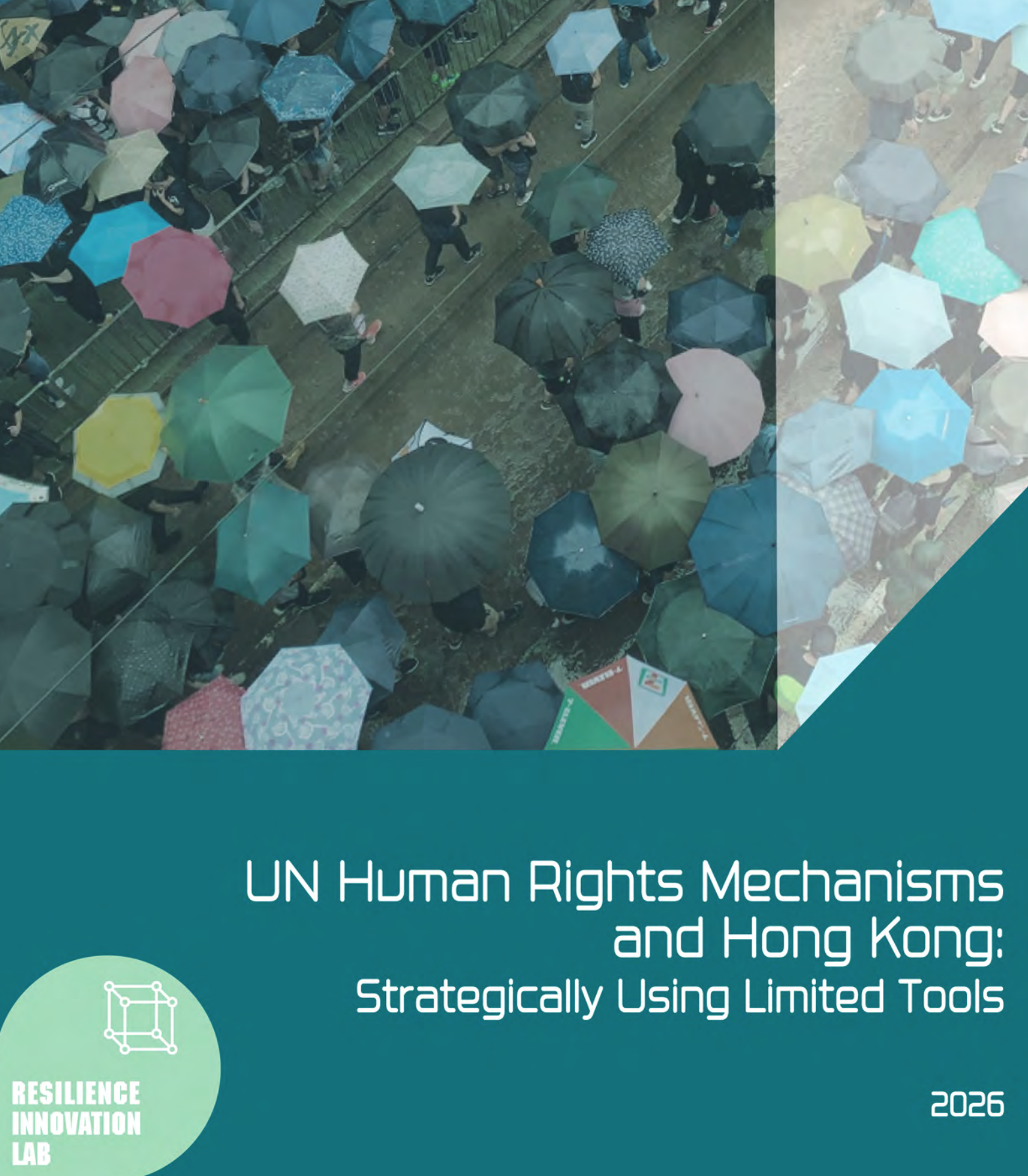
RIL has published a new report, UN Human Rights Mechanisms and Hong Kong: Strategically Using Limited Tools.
The report maps and analyses the responses of UN treaty bodies, Special Procedures, the Human Rights Council and the Office of the High Commissioner for Human Rights to developments in Hong Kong since the introduction of the National Security Law. It also considers how UN recommendations and international human rights discourse can continue to support human rights education, advocacy and rule-of-law resilience despite the limited enforcement powers of international mechanisms.
Tiananmen vigil organisers convicted of inciting subversion

Photo: BBC News
On 21 August, Hong Kong’s High Court convicted former Hong Kong Alliance leaders Chow Hang-tung and Lee Cheuk-yan of inciting subversion under the National Security Law. The now-disbanded Hong Kong Alliance, which organised Hong Kong’s annual Tiananmen vigils for decades, was also convicted. A third former leader, Albert Ho, had earlier pleaded guilty to the same charge.
The court found that the Alliance’s longstanding call to “end one-party dictatorship” amounted to an attempt to overthrow the constitutional order. Chow and Lee face up to ten years’ imprisonment, with mitigation proceedings scheduled for 28 August before sentencing.
Human Rights Watch called for the convictions to be quashed, arguing that the prosecution violated the defendants’ rights to freedom of expression and peaceful assembly.
RSF warns of escalating harassment against the Hong Kong Journalists Association
Reporters Without Borders (RSF) has condemned what it describes as an escalating campaign of harassment against the Hong Kong Journalists Association (HKJA) and its members.
RSF pointed to reported incidents including doxxing, threats, surveillance, stalking and intimidating messages directed at journalists and media organisations. It also noted that at least 20 individuals and seven independent media organisations, including HKJA, have faced tax audits over the past two years.
RSF said the pressure risks further discouraging journalists from organising collectively and defending press freedom in an already severely restricted media environment. Hong Kong ranked 140th out of 180 jurisdictions in RSF’s 2026 World Press Freedom Index.
Useful Resources
Judicial Records in Hong Kong * has made every effort to collect court decisions related to the Anti-Extradition Bill Movement for educational and research purposes. These records are still accessible on the website of Hong Kong’s judiciary, but their continued availability to the public in the future remains uncertain. All judicial records collected and displayed here are secured and maintained using blockchain technology, through which they are decentralized and immutable, ensuring transparency, tamper-resistance, and trust in the integrity of the data. Our goal is to utilize blockchain as a form of censorship resistance to preserve invaluable public records. If there are any omissions in this database, please feel free to notify RIL’s research team: info.dap@protonmail.com .
*To protect your identity and personal information, you are advised to use these online resources with an encrypted device and VPN.
An Unbreakable Wall? Challenges and Opportunities of Defending Freedom of Information in China is RIL’s first research report on information environment in China. This report provides a comprehensive account of China’s information environment under the rule of the CCP. Drawing on evidence-based insights from multiple perspectives, the report seeks to inform a broad range of stakeholders—from policymakers and international businesses to civil society organisations and academic institutions—and encourages collaborative efforts to address the challenges posed by China’s information landscape and its impact on global information networks. The full report is now available on our website.
Safeguarding Freedom of Information in Hong Kong: Challenges, Opportunities and Remedies is RIL’s second research report, focuding on information freedom in Hong Kong. The report systematically outlines how Hong Kong’s information access environment has been significantly constrained since the implementation of the Hong Kong National Security Law (HKNSL) in 2020 and the Safeguarding National Security Ordinance (SNSO) in 2024. These measures have severely curtailed press freedom and undermined the ability of civil society to hold the government accountable. They have encouraged the withholding of publicly available data and represent a departure from international human rights standards. Access to and dissemination of information is increasingly criminalised, resulting in diminished government transparency, suppression of the media, and reduced accessibility to data for businesses. The repercussions are being felt by journalists, the business sector, researchers, and international organisations alike. The report is published bilingually on our website.
Authoritarian Innovation: How China Is Building Control into Generative AI Systems is RIL’s third report. Co-authored with Strategic China Policy Group (SCPG), the report draws on official sources and technical standards to examine how Beijing is embedding information control into large language models through its content security framework, standards, and model governance.
Keeping Calm Amid Uncertainty: An Information Security Resilience Guide for Civil Society (Tradtional Chinese only) is a practical manual developed by RIL for Hong Kong civil society, diaspora communities, journalists, advocates, students, and community organisers seeking to strengthen their digital safety. The guide offers accessible advice on common information security risks, secure communications, device and account protection, AI-related privacy concerns, and digital preparation for travel or cross-border activities. Framing information security as both personal protection and collective care, the manual helps individuals and organisations reduce risks, safeguard trusted networks, and build stronger civic resilience in an uncertain political, legal, and technological environment.
Working with Difficult Records Series is a webinar series organised by The National Archives UK. This series explores how archives can engage with challenging and sensitive records through people-centred and trauma-informed approaches. Bringing together scholars, practitioners, and sector experts, the sessions share practical case studies, reflections, and strategies that emphasise care, empathy, and community in archival work. Participants will gain insight into managing distressing material, supporting wellbeing, and applying trauma-informed practices to strengthen both professional practice and funding opportunities, while also building a collaborative community of practice. Topics include working with traumatic histories, criminal justice, medical and mental health records, social justice collections, and beneficiary-focused archives.
The “Hive Mind Series” is launched by the International Coalition of Sites of Conscience (ICSC). ICSC brings together its network to lead conversations shaping the future of memory and justice work. The series explores a wide range of topics, including Documentation and Integration: Documenting the Stories of Refugees, Collective Memory and Non-Repetition in Latin America, Supporting Sustainable Peace: Funding for Transitional Justice, Early Warning Systems, Community Documentation and Atrocity Prevention, and other timely issues influencing the future of memory practice and transitional justice. By bringing together diverse perspectives and experiences, the series aims to foster meaningful exchange, encourage collaborative learning, and highlight approaches that strengthen locally informed initiatives around the world.

Who we are?
Resilience Innovation Lab (RIL) was founded by Asian veteran researchers and human rights defenders in 2023. RIL is a virtual platform promoting innovation, experimentation, and the exchange of research and educational initiatives that aim to develop and strengthen the democratic and digital resilience of organisations and individuals working in repressive environments.
RIL envisions a synergy of democracy, technology and civil society resilience today, especially when authoritarianism emerges as a common threat to liberal democracies and open societies. Building the capacities of citizens and civil groups to respond to such a new environment with creative and innovative instruments is of paramount importance for their sustainable development.
Our work focuses on researching Web3 technology, digital preservation of collective memory and history in conflict and post-conflict areas, and resilience of rule of law institutions and cultures in non-democratic regimes.
Enquiry: info.ril@proton.me