
Welcome to Resilience Innovation Lab (RIL). As we welcome the Year of Horse, RIL would like to extend our heartfelt wishes to you for a year filled with peace, good health, and renewed hope.
In this newsletter, we will share updates on news related to the freedom of information in Hong Kong and China and updates on Hong Kong judicual records database.
Hong Kong Student Becomes First Whistleblower Arrested Under Anti-Doxxing Law
In what appears to be the first known case of a whistleblower being arrested for alleged doxxing in Hong Kong, Hailey Cheng, a student from the City University of Hong Kong, has been arrested following her role in exposing an academic integrity controversy linked to the AI medical app “MediSafe”.
The student had previously raised public concerns about the app’s development, questioning both the authenticity of claims surrounding its creation and whether proper safeguards were in place regarding the use of medical data. Her disclosures sparked widespread debate about academic standards and oversight. However, police have now arrested her on suspicion of violating Hong Kong’s anti-doxxing provisions under the Personal Data (Privacy) (Amendment) Ordinance, alleging that she disclosed personal data without consent in a manner that caused harm.
The case marks a significant development in the application of Hong Kong’s strengthened privacy regime, as it is the first time doxxing legislation has reportedly been used against an individual who had positioned herself as a whistleblower acting in the public interest.
The arrest underscores the significant legal risks faced by individuals who speak out on matters of public interest in Hong Kong. Even where concerns relate to academic integrity or data governance, whistleblowers may find themselves exposed to criminal liability under the city’s strengthened anti-doxxing provisions if their disclosures are deemed to involve personal data published without consent. This carries a potential chilling effect, particularly for students, researchers and professionals who may think twice before questioning high-profile projects or institutions. The application of Hong Kong’s 2021 amendments to the Personal Data (Privacy) Ordinance — introduced to curb harassment and protect privacy — now raises difficult questions about where legitimate whistleblowing ends and unlawful disclosure begins. Set against a broader backdrop of heightened legal scrutiny of activists, journalists and academics, the case may further narrow the space for open debate and reinforce self-censorship in matters of public concern.
Hong Kong Student Expelled After Petition Over Tai Po Fire
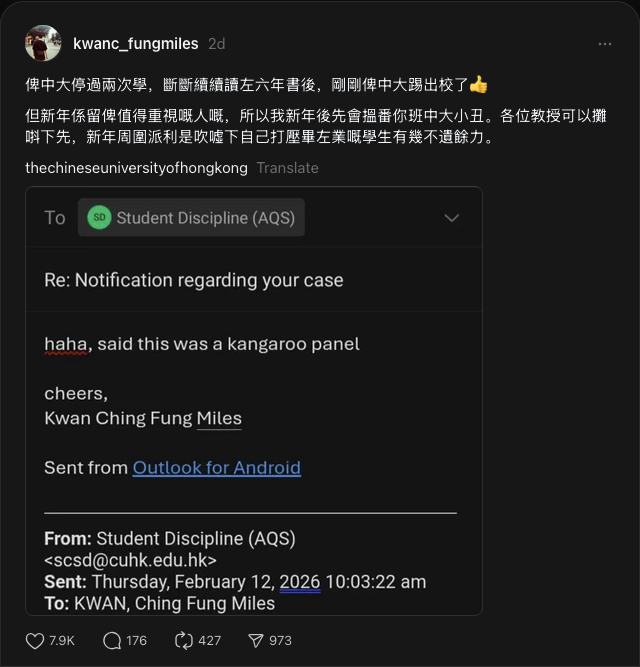
The Chinese University of Hong Kong (CUHK) has recently expelled a 24-year-old student.
Miles Kwan launched an online petition following the Tai Po Wang Fuk Court fire in November 2025, which claimed the lives of more than 168 people. The petition called for the establishment of an independent commission of inquiry into the blaze, support for displaced residents, a review of building regulatory oversight and government responsibility. It quickly garnered more than 10,000 signatures online before being removed. Kwan was arrested by the National Security Police in late November on suspicion of sedition and was subsequently released on bail. He stated that, in deciding to expel him, the university cited his previous disciplinary record and alleged breaches of confidentiality.
The case has drawn public attention to the state of freedom of expression and freedom of information in Hong Kong, with several human rights organisations urging the authorities to allow an open inquiry and public discussion of the tragedy.
China Scales Back Judicial Transparency
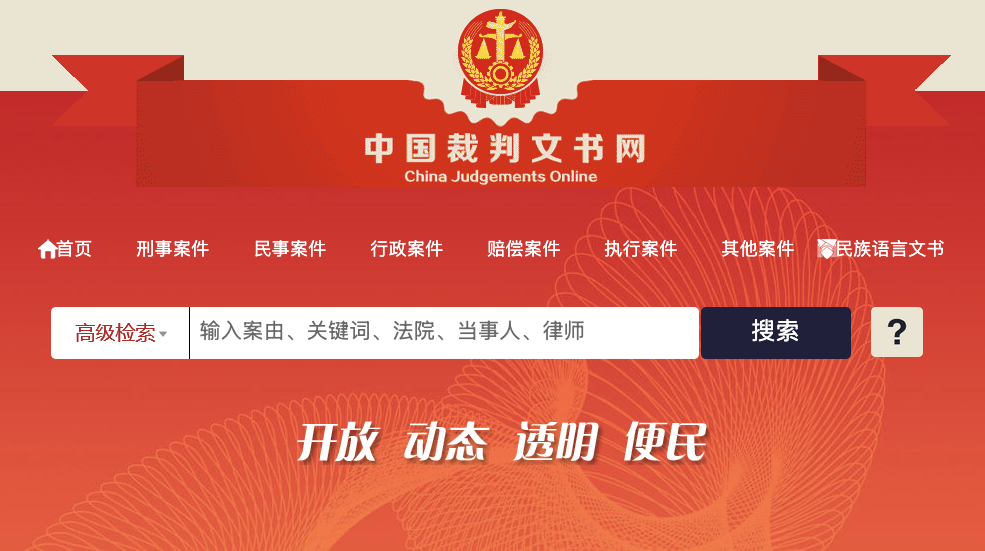
According to Radio Free Aisa Chinese, China has significantly reduced the number of court judgments published on its official judicial database, prompting concern among lawyers and legal scholars. The platform, China Judgments Online, was once presented as a flagship initiative to promote judicial transparency and public oversight. However, recent reports indicate that the volume of publicly available rulings has fallen sharply. In many cases, detailed judgments have been replaced with brief summaries, limited notices, or heavily redacted information.
Legal professionals warn that this shift makes it increasingly difficult to understand how courts reach their decisions. Missing case details — such as judges’ names, legal reasoning and full factual accounts — weaken the ability of lawyers to compare similar cases or assess consistency in the application of the law. Notably, there has been no clear public explanation from the Supreme People’s Court regarding the reduction in published material.
The implications extend beyond the legal profession. Judicial transparency has long been viewed as one of the few areas in which the Chinese government appeared to embrace limited institutional openness. The online publication of rulings allowed researchers, businesses and ordinary citizens to observe how laws were interpreted and enforced. The contraction of this access signals a broader tightening of information control.
For freedom of information in China, the development is significant. Reduced access to court decisions limits public scrutiny and diminishes accountability within the legal system. It also contributes to a more opaque governance environment, where the reasoning behind state decisions becomes harder to examine. As information channels narrow, concerns grow that transparency — once cautiously expanded — is now being steadily rolled back.
Updates on Judicial Records in Hong Kong database
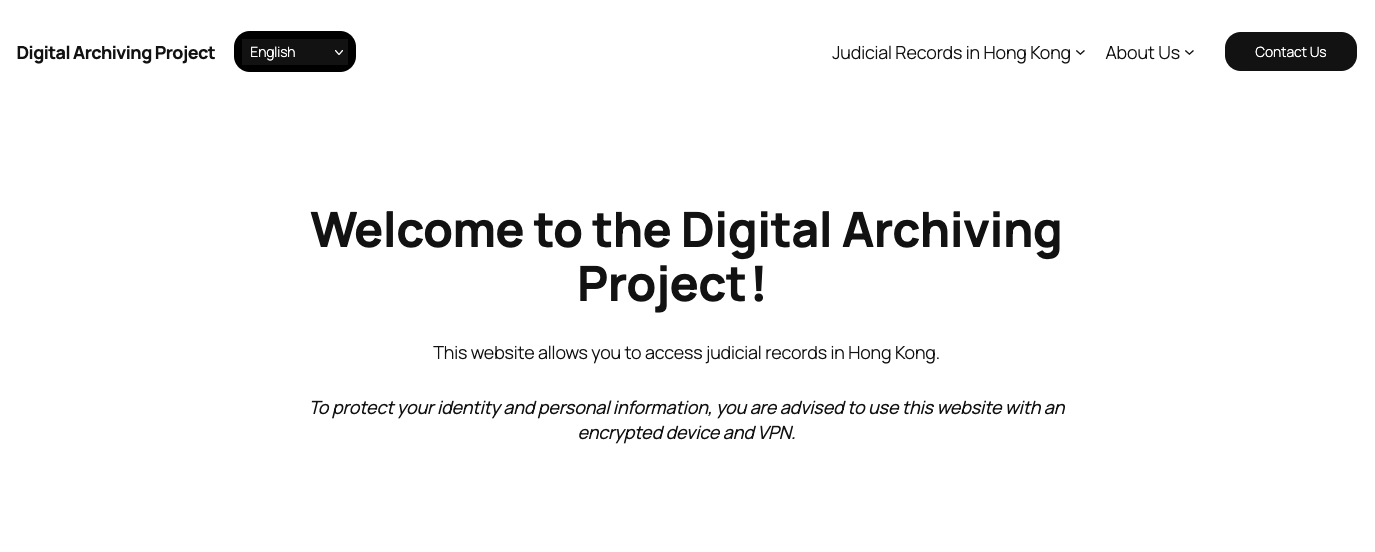
The Judicial Records in Hong Kong database is an open, searchable online platform that compiles judicial decisions and case details relating to the Anti-Extradition Bill Movement in Hong Kong. The database seeks to preserve publicly available judicial documents, particularly those of historical or research significance that may later be removed or become inaccessible due to their sensitive nature. By organising and presenting these records in a centralised digital format, the project supports legal researchers, journalists, civil society groups and members of the public in analysing trends within Hong Kong’s legal system.
The Digital Archiving Project has recently upgraded the database’s search engine. Users can now search not only by case number, but also by judge, plea, verdict, charge, location and sentence. These enhancements allow for more precise filtering of results, facilitating in-depth research and comparative analysis.
For example, users may search for cases presided over by a particular judge by selecting the relevant name from the “Judge” dropdown menu. The database will then display all cases within its records assigned to that judge, enabling users to review and analyse patterns across judgments.
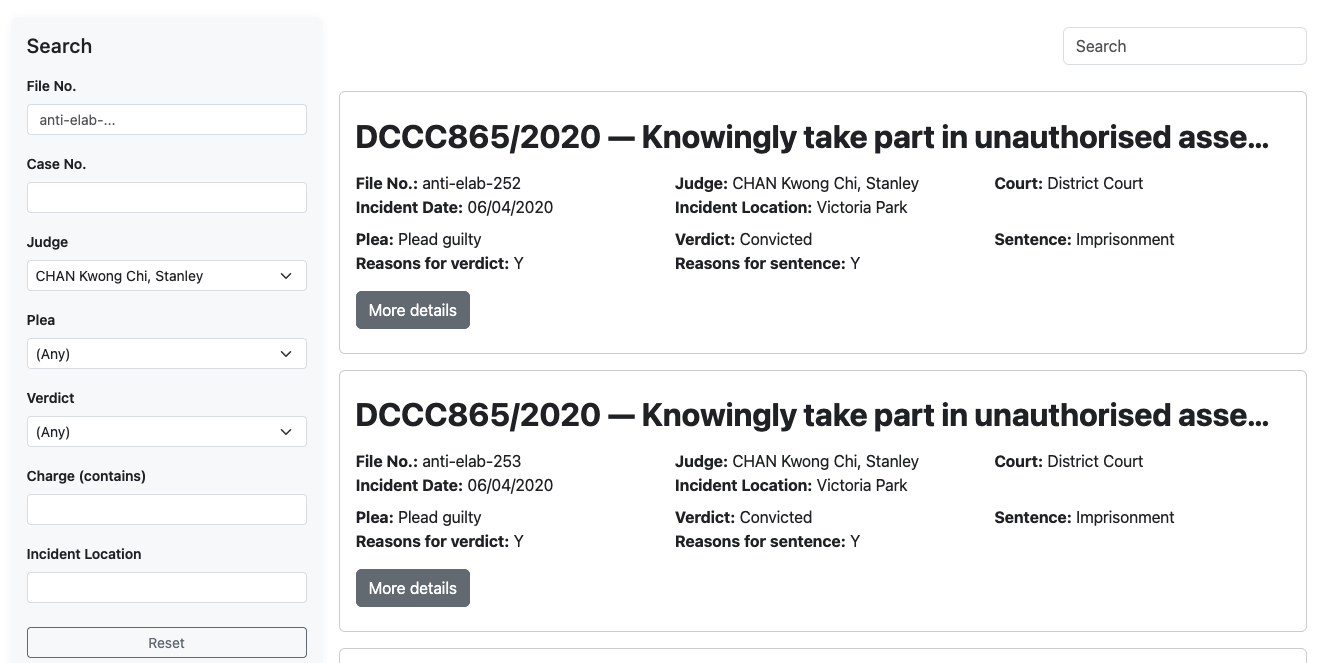
Each record contains structured information relating to a specific court case, including the case reference number, court level, charges, plea, verdict and sentencing outcome. In addition to these core details, each page provides a concise summary of the court’s reasoning and, where available, links to the full written judgment and sentencing remarks. To ensure long-term accessibility, relevant documents are also uploaded to blockchain storage for permanent preservation.
The content is organised in a standardised format to maintain consistency across records, enabling users to compare cases systematically and track legal developments over time.
Click here to access the database. (To protect your identity and personal information, you are advised to use this website with an encrypted device and VPN.)
Useful Resources
Judicial Records in Hong Kong * has made every effort to collect court decisions related to the Anti-Extradition Bill Movement for educational and research purposes. These records are still accessible on the website of Hong Kong’s judiciary, but their continued availability to the public in the future remains uncertain. All judicial records collected and displayed here are secured and maintained using blockchain technology, through which they are decentralized and immutable, ensuring transparency, tamper-resistance, and trust in the integrity of the data. Our goal is to utilize blockchain as a form of censorship resistance to preserve invaluable public records. If there are any omissions in this database, please feel free to notify RIL’s research team: info.dap@protonmail.com .
China Open Courts * aims to preserve and provide public access to judicial records from the People’s Republic of China that are at risk of disappearing from official sources. Below is an overview of the methodology adopted in this project, including our data collection strategies, scope of coverage, and plans for ensuring continued accuracy and relevance of the information. Interested parties are welcome to reach out to our team at chinaopencourts@protonmail.com for further information, collaboration opportunities, or suggestions on additional keywords and topics to include.
*To protect your identity and personal information, you are advised to use these online resources with an encrypted device and VPN.
An Unbreakable Wall? Challenges and Opportunities of Defending Freedom of Information in China is RIL’s first research report on information environment in China. This report provides a comprehensive account of China’s information environment under the rule of the CCP. Drawing on evidence-based insights from multiple perspectives, the report seeks to inform a broad range of stakeholders—from policymakers and international businesses to civil society organisations and academic institutions—and encourages collaborative efforts to address the challenges posed by China’s information landscape and its impact on global information networks. The full report is now available on our website.
Safeguarding Freedom of Information in Hong Kong: Challenges, Opportunities and Remedies is RIL’s second research report, focuding on information freedom in Hong Kong. The report systematically outlines how Hong Kong’s information access environment has been significantly constrained since the implementation of the Hong Kong National Security Law (HKNSL) in 2020 and the Safeguarding National Security Ordinance (SNSO) in 2024. These measures have severely curtailed press freedom and undermined the ability of civil society to hold the government accountable. They have encouraged the withholding of publicly available data and represent a departure from international human rights standards. Access to and dissemination of information is increasingly criminalised, resulting in diminished government transparency, suppression of the media, and reduced accessibility to data for businesses. The repercussions are being felt by journalists, the business sector, researchers, and international organisations alike. The report is published bilingually on our website.

Who we are?
Resilience Innovation Lab (RIL) was founded by Asian veteran researchers and human rights defenders in 2023. RIL is a virtual platform promoting innovation, experimentation, and the exchange of research and educational initiatives that aim to develop and strengthen the democratic and digital resilience of organisations and individuals working in repressive environments.
RIL envisions a synergy of democracy, technology and civil society resilience today, especially when authoritarianism emerges as a common threat to liberal democracies and open societies. Building the capacities of citizens and civil groups to respond to such a new environment with creative and innovative instruments is of paramount importance for their sustainable development.
Our work focuses on researching Web3 technology, digital preservation of collective memory and history in conflict and post-conflict areas, and resilience of rule of law institutions and cultures in non-democratic regimes.
Enquiry: info.ril@proton.me