
Welcome to Resilience Innovation Lab (RIL). Before diving into this month’s newsletter, we would like to send you our Easter wishes—may the season bring fresh beginnings, joy, and a touch of springtime warmth.
In this newsletter, we will share updates on the new bylaw under Hong Kong’s National Security Law (NSL).
Hong Kong’s New NSL Amendments Expand Enforcement Powers and Raise Civil Liberties Concerns
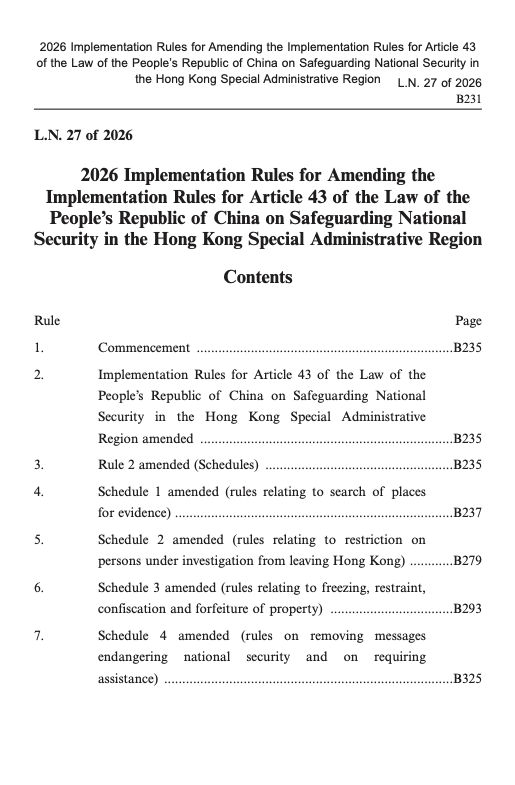
On 23 March 2026, the Hong Kong government gazetted amendments to the NSL’s implementation rules, and they took effect immediately. The government says the changes are meant to strengthen enforcement, clarify procedures and reflect practical experience from recent cases, while preserving judicial gatekeeping for certain measures.
The most notable change is a new mechanism allowing police, in national security investigations, to require a specified person to provide passwords, decryption methods or other assistance to access electronic devices. News reporting says refusal can lead to up to one year’s imprisonment and a HK$100,000 fine, while providing false or misleading information can carry up to three years’ imprisonment and a HK$500,000 fine.
The amendments also tighten procedures around legal professional privilege, clarify penalties for breaching departure restrictions, and expand powers relating to property confiscation, seizure of items suspected of having a seditious intention, and the removal or restriction of certain electronic messages. Taken together, these measures suggest a system that is becoming not only more detailed, but more intrusive and easier for authorities to use in practice.
For individuals, their personal devices, communications and online activity may now be more vulnerable to compelled access, while tighter procedures around legal professional privilege and stronger travel-related restrictions could make it harder for affected persons to protect their rights. The cumulative effect may be a further chilling effect on expression, association and the handling of confidential materials.
For businesses, especially companies handling sensitive data, the amendments raise both compliance and operational risks. Firms may need stronger protocols for device access requests, encryption and key management, privilege review, document retention, staff travel, content moderation and supply-chain screening, particularly where employees, goods, funds or cross-border data flows could become linked to an investigation.
The expanded decryption powers, tighter timelines for asserting privilege, broader content-removal powers and increased confidentiality around certain notices as raising fresh concerns about privacy, freedom of expression, access to legal advice, due process and the practical ability to challenge official decisions. Even where safeguards formally exist, critics may question how meaningful those protections are in practice when compliance obligations are immediate, penalties are severe and the scope of national security enforcement continues to widen.
Useful Resources
Judicial Records in Hong Kong * has made every effort to collect court decisions related to the Anti-Extradition Bill Movement for educational and research purposes. These records are still accessible on the website of Hong Kong’s judiciary, but their continued availability to the public in the future remains uncertain. All judicial records collected and displayed here are secured and maintained using blockchain technology, through which they are decentralized and immutable, ensuring transparency, tamper-resistance, and trust in the integrity of the data. Our goal is to utilize blockchain as a form of censorship resistance to preserve invaluable public records. If there are any omissions in this database, please feel free to notify RIL’s research team: info.dap@protonmail.com .
China Open Courts * aims to preserve and provide public access to judicial records from the People’s Republic of China that are at risk of disappearing from official sources. Below is an overview of the methodology adopted in this project, including our data collection strategies, scope of coverage, and plans for ensuring continued accuracy and relevance of the information. Interested parties are welcome to reach out to our team at chinaopencourts@protonmail.com for further information, collaboration opportunities, or suggestions on additional keywords and topics to include.
*To protect your identity and personal information, you are advised to use these online resources with an encrypted device and VPN.
An Unbreakable Wall? Challenges and Opportunities of Defending Freedom of Information in China is RIL’s first research report on information environment in China. This report provides a comprehensive account of China’s information environment under the rule of the CCP. Drawing on evidence-based insights from multiple perspectives, the report seeks to inform a broad range of stakeholders—from policymakers and international businesses to civil society organisations and academic institutions—and encourages collaborative efforts to address the challenges posed by China’s information landscape and its impact on global information networks. The full report is now available on our website.
Safeguarding Freedom of Information in Hong Kong: Challenges, Opportunities and Remedies is RIL’s second research report, focuding on information freedom in Hong Kong. The report systematically outlines how Hong Kong’s information access environment has been significantly constrained since the implementation of the Hong Kong National Security Law (HKNSL) in 2020 and the Safeguarding National Security Ordinance (SNSO) in 2024. These measures have severely curtailed press freedom and undermined the ability of civil society to hold the government accountable. They have encouraged the withholding of publicly available data and represent a departure from international human rights standards. Access to and dissemination of information is increasingly criminalised, resulting in diminished government transparency, suppression of the media, and reduced accessibility to data for businesses. The repercussions are being felt by journalists, the business sector, researchers, and international organisations alike. The report is published bilingually on our website.
Working with Difficult Records Series is a webinar series organised by The National Archives UK. This series explores how archives can engage with challenging and sensitive records through people-centred and trauma-informed approaches. Bringing together scholars, practitioners, and sector experts, the sessions share practical case studies, reflections, and strategies that emphasise care, empathy, and community in archival work. Participants will gain insight into managing distressing material, supporting wellbeing, and applying trauma-informed practices to strengthen both professional practice and funding opportunities, while also building a collaborative community of practice. Topics include working with traumatic histories, criminal justice, medical and mental health records, social justice collections, and beneficiary-focused archives.

Who we are?
Resilience Innovation Lab (RIL) was founded by Asian veteran researchers and human rights defenders in 2023. RIL is a virtual platform promoting innovation, experimentation, and the exchange of research and educational initiatives that aim to develop and strengthen the democratic and digital resilience of organisations and individuals working in repressive environments.
RIL envisions a synergy of democracy, technology and civil society resilience today, especially when authoritarianism emerges as a common threat to liberal democracies and open societies. Building the capacities of citizens and civil groups to respond to such a new environment with creative and innovative instruments is of paramount importance for their sustainable development.
Our work focuses on researching Web3 technology, digital preservation of collective memory and history in conflict and post-conflict areas, and resilience of rule of law institutions and cultures in non-democratic regimes.
Enquiry: info.ril@proton.me