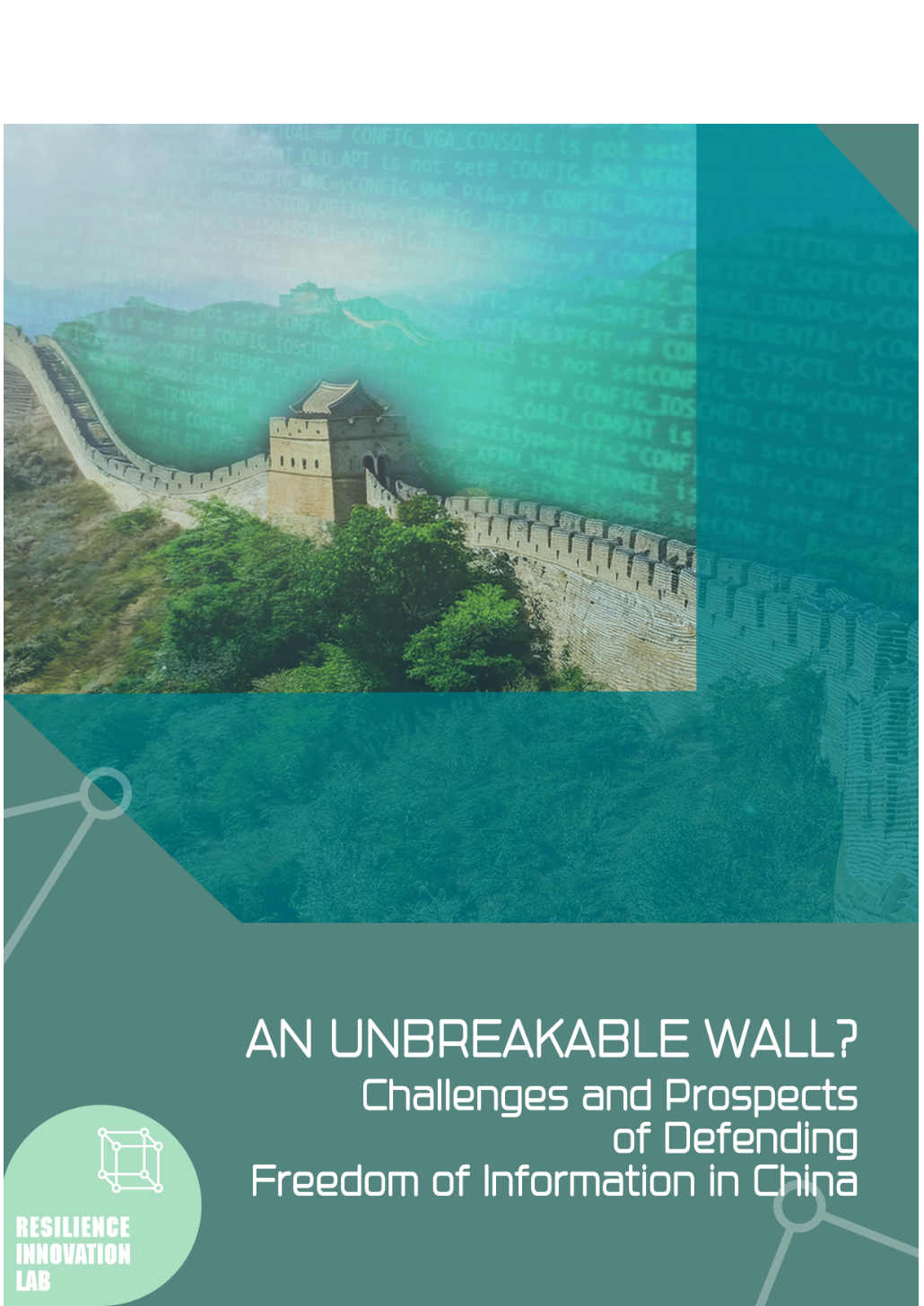
Resilience Innovation Lab (RIL) is pleased to launch its inaugural research report, titled An Unbreakable Wall? Challenges and Opportunities of Defending Freedom of Information in China. The full report is now available online.
Over the past decade, China’s information environment has deteriorated markedly due to increasing state control over digital communications. Notable escalations in censorship and surveillance have coincided with key events, including the 2019 Hong Kong protests, the COVID-19 pandemic in 2020, and the White Paper Movement in 2022. The Chinese Communist Party (CCP) has systematically tightened its grip on cyberspace, driven by concerns over foreign ideological influence and the safeguarding of domestic regime security.
Businesses—particularly multinational corporations—face growing risks as China’s digital environment becomes ever more restrictive. Due diligence operations have been significantly hindered, with organisations subjected to raids, exit bans, informal government warnings, and limited access to essential corporate information databases. Civil society organisations, journalists, and academics face similar constraints, including routine surveillance, censorship, and major operational disruptions. Academic freedom, journalistic independence, and civic activism continue to be challenged by ambiguous legal frameworks, intensified surveillance, and direct threats from state authorities.
This report provides a comprehensive account of China’s information environment under the rule of the CCP, with a particular focus on developments since President Xi Jinping’s ascent to power. It offers a critical analysis of how systematic, state-led efforts to control and manipulate information are affecting various sectors of society—including the information supply chain, public access to information, and the operating conditions of businesses (especially within the due diligence sector), civil society groups, journalists, and academics engaged with China. Drawing on evidence-based insights from multiple perspectives, the report seeks to inform a broad range of stakeholders—from policymakers and international businesses to civil society organisations and academic institutions—and encourages collaborative efforts to address the challenges posed by China’s information landscape and its impact on global information networks.
Resilience Innovation Lab gratefully acknowledges the invaluable contributions of several anonymous individuals and interviewees who chose not to reveal their identities for safety and security reasons. Their courage and insight have greatly enriched the depth and authenticity of this report. We sincerely hope that, in the near future, contributors and researchers will no longer feel compelled to hide their identities, but will instead be free to participate openly in the pursuit of a free, transparent, and open society in China.
In social movements, Web3 technology is increasingly demonstrating its potential, particularly in the areas of financial independence and information freedom.
1/ Cryptocurrencies: Economic Freedom and Financial Privilege
First, let’s define the concept of “reserve currency”. A reserve currency is an internationally accepted and widely used currency within the global financial system. It is primarily used for international trade, payments, and foreign exchange reserves. Today, reserve currencies include the US dollar, the euro, and the Japanese yen, among a few others. However, statistics show that less than 20% of the world’s population lives in countries that issue reserve currencies, meaning that the majority of nations must rely on these international currencies for trade and financial transactions.
As Alex Gladstein, CEO of the Human Rights Foundation, describes in his book Check Your Financial Privilege, this unequal distribution of currency has created what is known as “financial privilege”. Countries with reserve currencies enjoy greater financial stability, while others are more vulnerable to currency fluctuations and economic instability.
For example, many South American countries have long struggled with hyperinflation. In Venezuela, inflation soared to 1,000,000% in 2018, rendering the local currency almost worthless. As a result, residents had to seek alternative stores of value, with many turning to cryptocurrencies such as Bitcoin to protect their assets and safeguard against the collapse of the domestic financial system. Similarly, in Ethiopia, government restrictions prevent residents from holding US dollars, severely limiting their financial freedom. The emergence of cryptocurrencies has provided a way to bypass government-imposed restrictions, allowing individuals to maintain essential economic activities.
2/ Cryptocurrencies: “Economic Terrorism” and Financial Control
Beyond financial privilege, another serious issue is the phenomenon of “economic terrorism”. This refers to a tactic employed by authoritarian governments, where monetary supply manipulation is used to control people’s economic freedom and further entrench corruption. In Sudan, prolonged economic sanctions and government corruption have made it extremely difficult for citizens to access international currencies or even obtain basic financial services. The Sudanese government not only restricts financial freedom but also manipulates the monetary supply to maintain its grip on power. In such an environment, cryptocurrencieshave emerged as a tool to circumvent government control, allowing local residents to safeguard their financial autonomy.
Another noteworthy example is Palestine. Due to Israeli control, Palestine is unable to establish its own monetary system, forcing residents to use the Israeli currency for transactions. Even when international aidis provided to Palestinian civil society, it is only distributed in Israeli currency, inadvertently strengthening Israel’s financial system. This creates a dilemma for Palestinian activists and ordinary citizens—how can they accept external funding without further reinforcing the very financial system they oppose?
For many Palestinian activists, cryptocurrencies—particularly Bitcoin and stablecoins—offer a solution to this predicament. By using cryptocurrencies, they can circumvent the Israeli financial system while also protecting their financial privacy and freedom. For them, using cryptocurrencies is not just an economic survival strategy—it is a form of “everyday activism”. In this context, cryptocurrencies are not only transforming financial behaviour but also serving as a powerful expression of resistance against financial oppression.
3/ Cryptocurrencies as a Donation Tool for Supporting NGOs
The rise of cryptocurrencies has provided non-governmental organisations (NGOs) and social movements with new channels for receiving donations, particularly when traditional financial systems are subject to intervention.
A notable example is WikiLeaks. After exposing a vast number of classified documents, the organisation faced financial blockades from major banks worldwide. Even in Switzerland, a country known for its strict banking secrecy laws, WikiLeaks’ bank accounts were frozen. At this critical moment, Bitcoin became a lifeline for WikiLeaks. Supporters were able to bypass the restrictions of the traditional financial system and continue funding the organisation through cryptocurrency donations. This case highlights the importance of having a currency that operates independently of traditional financial institutions, ensuring that oppressed groups and individuals can still receive international support despite external financial pressure.
4/ Cryptocurrencies for Humanitarian Aid
Cryptocurrencies are now widely used in humanitarian aid, particularly for communities that lack access to traditional banking systems.
A key example is Stellar’s aid programme, which provides fast, low-cost blockchain payment solutions to support unbanked refugees. Similarly, the United Nations High Commissioner for Refugees (UNHCR) has been exploring this technology, using cryptocurrencies to directly distribute aid funds to refugees—overcoming the barriers that prevent traditional banks from serving these populations. The success of these aid initiatives demonstrates the potential of cryptocurrencies as a global humanitarian tool, offering lifeline support to those who have been excluded from the traditional financial system.
5/ Global Trends in Cryptocurrency Bans
These cases illustrate how cryptocurrencies, as an economic tool, have helped people in various social and political contexts break free from authoritarian governments and unstable financial systems, ultimately achieving economic freedom.
Despite the positive economic and social impacts of cryptocurrencies, concerning trends have begun to emerge worldwide. For instance, a recently proposed EU law not only sets limits on cash payments but also seeks to ban anonymous cryptocurrency transactions—a move that has been criticised as “financial paternalism”.
Governments typically justify such measures as necessary to combat money laundering by terrorist organisations and criminal groups. However, these regulations often disproportionately affect social activists and ordinary citizens, rather than the criminals they are meant to target. Meanwhile, wealthy and well-resourced criminals often find ways to circumvent these regulations, leaving everyday people subjected to increased financial surveillance and restrictions.
Therefore, discussions surrounding such policies must be approached with greater caution, ensuring that the regulations do not ultimately harm the very people they are meant to protect.
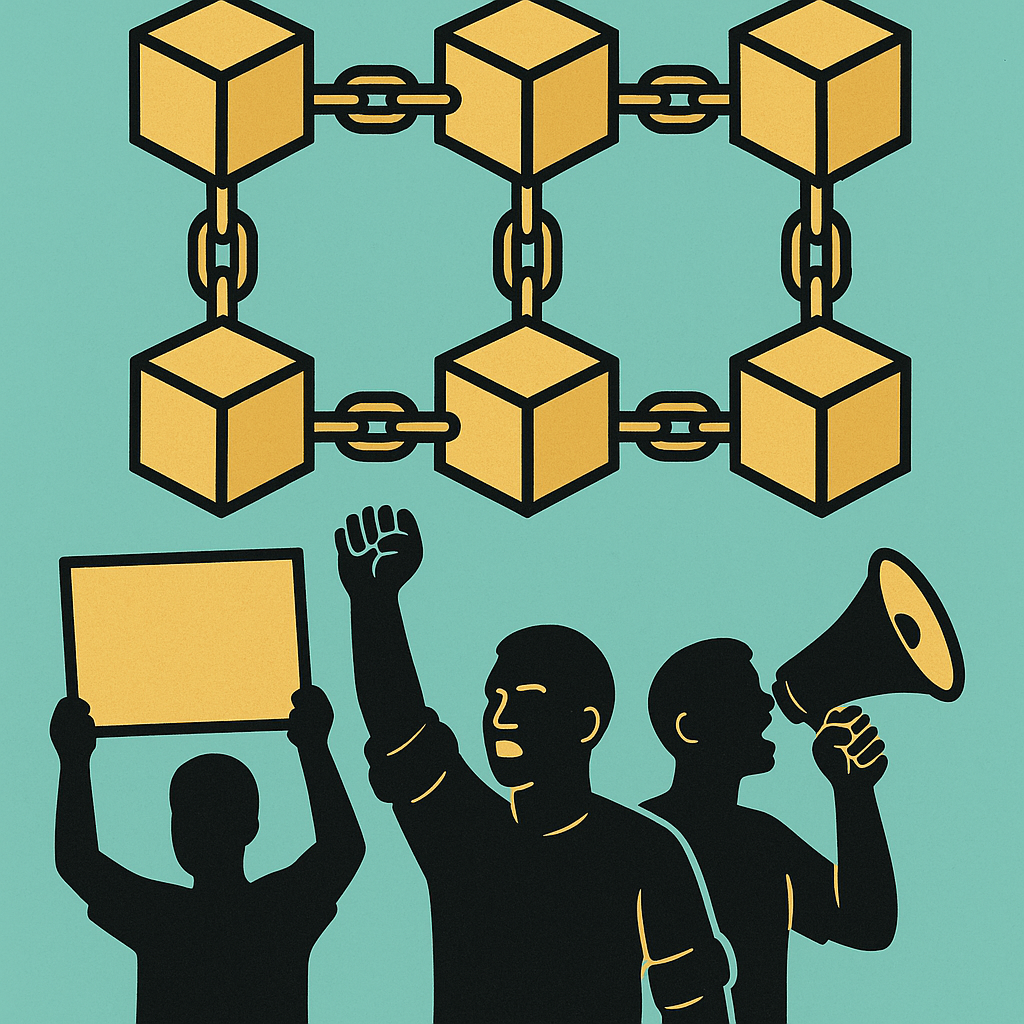
As the foundational technology of Web3, blockchain is essentially a distributed ledger technology. By leveraging decentralisation, blockchain ensures data immutability and transparency. Specifically, a blockchain consists of a series of interconnected “blocks”, each containing a set of transaction records. These blocks are linked together in chronological order, forming a continuous chain. When a new transaction occurs, it is bundled into a new block, which is then verified by miners or validators within the network through solving complex mathematical problems. Once a majority of nodes reach consensus, the new block is added to the blockchain, and this information is permanently stored and cannot be altered.
To better understand how blockchain works, we can use a common analogy: Google Sheets. The concept of a ledger serves as a good starting point—it is a fundamental accounting tool used to track the inflow and outflow of funds within a specific account (such as a bank account).
Blockchain, however, is a distributed ledger, which can be likened to a Google spreadsheet that allows multiple people to view and edit the rows and columns simultaneously. This distributed nature means that everyone can participate, without the need to rely on a centralised authority for management.
Next, we can explore some key characteristics of blockchain:
Permissionless/Trustless: Blockchain is an open network, meaning that anyone with internet access can participate without the need to trust any central authority. It is a permissionless system, allowing users to join the network at any time to verify and record transactions.
Decentralised/Distributed/Democratic: Unlike traditional centralised systems, blockchain is not controlled by a single entity. Instead, it operates through the collaboration of multiple participants, with each node holding a complete copy of the data, ensuring transparency and resistance to censorship.
Immutable: Once data is added to the blockchain, it cannot be altered or deleted. This guarantees the authenticity and integrity of all transactions, preventing anyone from tampering with past records and thereby enhancing trust.
Censorship-resistant: Blockchain relies on a distributed network to store data, making it difficult for any single entity to censor or remove information. This censorship-resistant feature is crucial for protecting freedom of speech and preventing the unjust deletion of data.
Through these features, blockchain functions as a distributed ledger that not only ensures data security and transparency but also provides a decentralised and open platform for internet participants.
In the information age, technology has not only transformed our way of life but has also provided new tools for social movements. When traditional media and social platforms become targets of censorship, Web3 technology is quietly emerging, offering new hope and possibilities for those who yearn for freedom of speech and social justice. The advent of blockchain technology ensures that the truth is permanently recorded and cannot be erased, allowing ordinary people to engage in resistance in unprecedented ways and ultimately change the world.
A thought-provoking example occurred during China’s #MeToo movement. When online platforms such as WeChat and Weibo swiftly deleted posts exposing Peking University’s cover-up of a sexual assault case, a public letter written by student Yue Xin faced the same fate. The government’s censorship system attempted to erase this letter, which revealed the campus scandal. However, blockchain technology became the last stronghold for these suppressed voices. Users of the Ethereum blockchain embedded Yue Xin’s letter into a transaction with zero monetary value, ensuring that the letter would exist permanently on the blockchain, accessible to anyone who browses the public ledger. This event holds historical significance, reminding us that the immutability of blockchain provides an ultimate tool to circumvent censorship.
Although, at the time, this technology had limitations in terms of widespread information dissemination, its potential is undeniable. The phrase “No 404 errors on the blockchain” aptly illustrates how Web3 technology grants suppressed voices a permanent record. This is not just a technological advancement—it is a shift in power, demonstrating that even the smallest spark can ignite a fire capable of changing the world.
Through such technology, social movements can transcend national borders and bypass censorship systems, evolving into an unstoppable global wave. Whether for resistance, human rights protection, or the fight against injustice, Web3’s decentralisation and immutability provide us with new tools and methods to drive social progress.
Although these technologies may seem distant, their influence is subtly permeating our daily lives. They symbolise every courageous voice and every unyielding soul that refuses to bow to oppression. In these challenging times, Web3 technology is like a small spark quietly spreading into a blazing fire, inspiring more people to believe that we can harness the power of technology to change the world.
A Comparison of Web1, Web2, and Web3
Throughout the development of the internet, Web1 was its earliest form, primarily characterised by “reading”. During this period, users could only passively browse content on web pages, with the internet serving a relatively simple function—mainly for information retrieval. This phase lasted roughly from the early 1990s to the early 2000s. Typical Web1 applications included early websites and personal homepages, most of which were static and did not support user interaction.
With technological advancements, the internet entered the Web2 era, defined by “writing”—meaning that users were no longer just passive consumers but could also create, edit, comment on, and share content. The rise of Web2 led to the emergence of highly interactive platforms such as social media, blogs, and forums, transforming the internet from a mere information dissemination tool into a global interactive platform. From the early 2000s to the early 2010s, Web2 was exemplified by platforms likeFacebook, Twitter, and YouTube, which allowed users to create and share content, significantly reshaping how information was distributed.
At present, we are witnessing the emergence of Web3. Unlike its predecessors, Web3 emphasises “ownership”, meaning that users are not just participants in the internet but also owners of digital assets. At its core, Web3 is built on decentralisation, ensuring that data is no longer controlled by a single central authority but is collectively maintained by all network participants. This shift is driven by blockchain technology, and Web3’s applications extend beyond finance to include decentralised applications (dApps), digital identity verification, and NFTs. The ultimate goal of Web3 is to create a more transparent and equitable internet, where users truly own their data and digital assets.
Social Mobilisation and Challenges in the Internet Era
Throughout the development of Web1 and Web2, their close connection with social movements has been particularly noteworthy. In the Web2 era, the explosion of social media enabled citizens to mobilise and collaborate in unprecedented ways, giving rise to globally influential protest movements such as the Arab Spring, the Umbrella Movement, and Occupy Wall Street. These movements benefited from the openness of the internet and the rapid dissemination capabilities of social media, allowing users to share information, organise events, and attract global attention in a short period. However, Web2 also revealed certain limitations when it came to mass mobilisation.
For instance, as governments tightened their control over digital spaces, information censorship and data removal became commonplace. In the second half of 2022, the Hong Kong government submitted 183 content removal requests to Google, particularly concerning content related to the National Security Law. At the same time, the ban on the protest song “Glory to Hong Kong” sparked concerns over freedom of speech, with some even fearing that Google might withdraw from the Hong Kong market as a result. These examples illustrate that, although the Web2 era empowered users to express themselves and organise movements, the centralised nature of platforms means they remain susceptible to government and corporate pressure, restricting the flow of information and the ability to mobilise.
In contrast, Web3 has the potential to address these issues through decentralised technology, offering a more secure and censorship-resistant platform for social movements.
For more insights into Web3’s characteristics and its application in social movements, refer to our publication: “Decentralized Archiving: A Beginner’s Guide to Web3 Preservation”!
Resilience Innovation Lab (RIL) is delighted to share a New Year’s gift with you: our first publication, “Decentralized Archiving: A Beginner’s Guide to Web3 Preservation”!
Discussions about blockchain, crypto wallets, NFTs, and other Web3 tools are abundant, but rarely do they focus on how these technologies can be leveraged to resist censorship and counter authoritarian suppression of human rights. This guide aims to help Web3 beginners, human rights defenders, archivists, researchers, and creative professionals understand the fundamental concepts of Web3 technology in digital archiving.
Designed primarily for people living under oppressive regimes, this handbook provides practical insights and essential knowledge to enable safer and more decentralized digital preservation. Web3 technology not only facilitates information flow and freedom of expression but also empowers scholars, journalists, activists, and artists to permanently store important and valuable resources—including publications, data, graphic works, and multimedia archives—on the web.
Whether you are concerned about privacy, passionate about human rights, or interested in archival activism to create a more democratic and open digital space, this guide offers the knowledge and resources you need. In this ever-changing digital era, we invite everyone to become a guardian of history and a sharer of truth!
As of now, this guide only has Traditional Chinese version. We will develop multilingual versions of the guide in the future, Stay tuned!
As we welcome the Year of the Snake, we extend our heartfelt wishes for a year filled with wisdom, resilience, and prosperity. The snake symbolizes transformation and renewal, reminding us to embrace change and new opportunities. At Resilience Innovation Lab (RIL), we are grateful for your continued support in our mission. Your dedication and commitment inspire us to keep innovating and building a future that fosters collaboration, transparency, and inclusivity.
In the spirit of renewal, we are thrilled to announce the launch of our first publicly-available database, powered by Web3 technology. This initiative represents a major step forward in preserving and securing valuable open source data through decentralized and transparent systems. With this innovative platform, we aim to empower our community with greater access, security, and trust in data sharing—ensuring that knowledge remains open and immutable for future generations.
May this Lunar New Year bring you happiness, success, and new possibilities. We look forward to growing together and making a lasting impact in 2025 and beyond. Thank you for being a part of our journey!